Wednesday, 30 November 2016

The city and the stars

Having recently read Arthur Clarke's The City and the Stars, I can't help but reflect on the strangeness of the world Clarke lets us inhabit in his books. Isn't it always a world on the verge of a great discovery? I'm thinking not only of this book, but also works like, say, Rama or 2001: A Space Odyssey. There's a sweet and thrilling sense of possibility that the universe just might take us on a fantastic voyage towards previously unimaginable power and knowledge, a sense of humanity just being about to pass a threshold that will unlock some marvellous evolution or possibility of limitless expanse. What we have here, I think, is a very peculiar atmosphere, one that needs to be understood in the context of the lingering belief in progress characteristic of the 20th century before the onset of postmodernism. At the same time, this is no ordinary trust in progress. It is, I would say, distinguished by two peculiarities that probably also need to be understood historically.

Firstly, another "strange" trait of Clarke's universe is that it lacks conflict. There are protagonists but not really any antagonists. HAL in 2001 might be terrifying, but is just a dysfunctioning machine with no malicious purpose. In the end it proves to be but a minor stumbling block on Bowman's triumphant evolutionary journey. Alien intelligences are never hostile. If anything, they are benevolent and ready to guide humanity to greater evolutionary heights. To evolve, however, human beings need to overcome their limitations in the form of superstitions and fears. If we just venture forth with courage, we'll discover how unfounded our fears are. In The City and the Stars, the protagonist Alvin discovers that the “invaders” are a myth, a false memory hindering humankind from venturing outside their isolation on earth and used to justify their fear of the universe. In 2001 humankind even gets the paternalistic guidance of these higher beings to steer itself onwards in evolution. What's so peculiar here is that Clarke's narrative, despite the absence of antagonists, still works as literature. Even without conflict, he somehow manages to make the reader want to go on reading.

Secondly, these books all circle around what can be termed the problem of unbalanced progress. Crudely put, it goes like this: while humanity has made enormous technological progress, it still lags behind morally and spiritually. This has resulted in the horrors of totalitarianism and the world wars and the madness of the cold war, and to survive on this planet we need to achieve spiritual development to restore balance. This is a lament that was very much in the air in the mid-20th century. It may very well have been the dominant idiom in which the criticism of technology was expressed in the decades before the onset of postmodernism. It seems to pop up almost simultaneously in a series of writers from the Frankfurt School to Lewis Mumford. In science fiction, we can see it in Isaac Asimov's Foundation novels, where the "first" foundation with its technological mastery needs to unite with the mysterious and psychologically advanced "second" foundation in order to end the centuries of barbary. Unbalanced progress is also a dominant motif in Clarke. It is powerfully present in 2001, which quite explicitly presents a philosophy of history organized around humanity's two successive evolutionary leaps - each one triggered by a black monolith left behind by benevolent aliens - the fist of which triggers technological progress and second of which triggers a kind of spiritual evolution. In The City and the Stars, humanity only exists on two spots on earth: on the one hand the technologically superior Diaspar which is ruled by a computer and on the other hand the low-tech but spiritually evolved Lys where human beings communicate telepathically. The role of Alvin, the protagonist, is to be the mediator who brings them together.

Now, I'm going to leave this motif of unbalanced progress aside - I think it's quite evident in what ways it is rooted in a particular historical moment - and return to the curious lack of antagonism in Clarke's books. Combined with the belief in progress and the strange benevolence of aliens this yields what is easy to criticize as a highly ideological world view. What we see here is in fact the very same kind of ideology that imperialism used to justify itself. Imperialism has always described itself as benevolent, as bringing the blessings of a superior civilization to primitive peoples, as in fact lacking antagonism. In a way, the aliens of Clarke's 2001 and to a great extent also the extra-terrestrial empire of The City and Stars behaves exactly like the imperialist powers did according to their own ideological self-description. They didn't oppress or exploit anyone, they simply shared knowledge and guided those willing to learn onwards. In the same way, oppression and exploitation are missing in Clarke's universe. To use Karl Wittfogel's categories, we might say that the earth's position in relation to the advanced alien civilizations is like that of a "submargin" rather than a "margin". According to Wittfogel, the margin was the barbarous borderland of the empire and was often politically dominated by the latter, while the submargin was beyond the reach of the empire's might but still close enough to receive small glimpses of its civilization and learn from it if it chose to do so. In Clarke's novels, the earth is clearly a submargin - almost always a backwater, seemingly to insignificant for alien civilizations to actually bother much about.

What I'm suggesting here is that Clarke's novels - with their conspicuous foregrounding of the idea of progress and their strange lack of conflict - present us with a reconfiguration of motifs familiar to readers through the experience of imperialism. On the one hand, his novels assume the position of the imperialist: the air of being on the cusp of great discoveries, the sense of adventure and the drive to explore - all of this can well be read as an attempt to evoke the sense of wonder and novelty believed to have animated European colonialist ventures and conquests in early modernity. But on the other hand, it is as if Clarke cannot quite allow himself to affirm this ethos. After all, imperialism is bad, a continuation of the lopsided and catastrophic kind of progress we've seen in modernity so far. And so he effects a replacement: what awaits us out there among the stars is not primitive peoples for us to enslave and exploit, but - on the contrary - higher beings, far more wise and powerful than we, who can help us evolve further in a better and more balanced way, and with this latter move, he paradoxically places us in the position, not of the conquering imperialist, but of the primitives gazing with wonder and awe at the imperial civilization and learning to take its first tottering steps on the road of genuine progress.

Naturally, the motif of the empire is also central to Asimov, and I suppose an interesting comparison could be made here between him and Clarke, but I think I'll stop here. The point I want to make is simply that there seems to be a cluster of motifs related to empire, technology and unbalanced progress that recurs in much of the science fiction of the early postwar decades and that - perhaps - feels somewhat unfamiliar and strange to readers today.


Thursday, 13 October 2016

The poet laureate of rock n' roll

We live in a fallen world. That's a sentence that makes sense even if you're not religious. Religious language is sometimes needed to express truth, even if truth is not what religion says it is. Few people have expressed this particular way of apprehending the world as well as Bob Dylan. Here are some of his most pregnant and memorable formulations:
I hear the ancient footsteps...
Sometimes I turn, there’s someone there.
Other times it’s only me.

The cards are no good that you’re holding, unless they’re from another world.
There’s no exit in any direction, ’cept the one you can’t see with your eyes.
One of the things that make Dylan an unforgettable experience is his meanness, his roughness or toughness, which is also a loneliness - the loneliness of a person trying to live in a fallen world without being swept away by depravity, without following others, without asking anyone else's opinion. This is also meanness towards oneself, an impatience with admirers, with recognition and with honors. His skill in giving voice to this meanness in his text is enough to make him one of the greatest poets I know. Here are a few more sentences, which I'll leave as they are, without context. Some are from his songs, others from interviews. They seem to work well that way, conveying the loneliness of their author, standing on their own, without help from others.
All the truth in the world adds up to one big lie. 
I think that this world is just a passing through place and that the dead have eyes and that even the unborn can see and I don’t care who knows it.

You always got to be prepared, but you never know for what.

Be kind because everyone you’ll ever meet is fighting a hard battle.
One more thing before I end. Many people seem to think he shouldn't have been awarded the Nobel Prize. Maybe they're right. But not because he doesn't deserve it. What would he do with the prize? He probably won't appreciate it. He'll always respect "the hearts and the hands of the men who come with the dust and are gone with the wind" far more than he respects the Swedish Academy. But even without the prize, he would be a hero of literature. He connects up with the roots of literature. If we think Francois Villon is a great poet, Dylan should be thought of as one as well.


Sunday, 11 September 2016

Who is the "Other" in The War of the Worlds?

It just struck me, but the "Other" of H. G. Wells's The War of the Worlds is not the Martian invaders. The Martians are a rather pale presence in the book. This might seem a curious thing to say considering that practically the entire book is taken up with gruesome descriptions of the destruction they bring. Yet despite this destruction, and the hideous details of their appearance, there's something about them that makes me think that Wells is uninterested in them. Unlike contemporaries like Jules Verne, Wells is also not very interested in space or the technical possibilities opened up by scientific progress; his concern seems rather to be with the moral state of humankind.

In fact, the most memorable scene of horror in the book is not any of the plentiful descriptions of destruction or suffering. It's surely the narrator's meeting with "the man on Putney Hill", a former artilleryman who appears to be the sole survivor in a vast, apocalyptic landscape of charred earth and strange Martian weeds near London. The artilleryman barely manages to scrape along, keeping himself alive in a shelter. "We're beat", he asserts with absolute conviction:
"It's all over," he said. "They've lost one - just one. And they've made their footing good and crippled the greatest power in the world. They've walked over us. (Wells 2005: 254)

"This isn't a war," said the artilleryman. "It never was a war; any more than there's a war between men and ants." (ibid. 254)   
"Cities, nations, civilization, progress - it's all over. That game's up. We're beat" (ibid. 257)
Despite this, the man has resolved to go on living: "for the sake of the breed. I tell you. I'm grim set on living" (ibid. 257). More specifically, he plans to live underground, even dreaming wildly about a future where humanity will be able to take revenge on the invaders:
I've been thinking about the drains. Of course those who don't know drains think horrible things; but under this London are miles and miles - hundreds of miles - and a few days' rain and London empty will leave them sweet and clean. The main drains are big enough and airy enough for anyone. Then there's cellars, vaults, stores, from which boltway passages may be made to the drains. And the railway tunnels and subways. Eh? You begin to see? And we form a band - able-bodied, clean-minded men. We're not going to pick up any rubbish that drifts in. Weaklings go out again. [...] Life is real again, and the useless and cumbersome and mischievous have to die. They ought to die. They ought to be willing to die. It's a sort of disloyalty, after all, to live and taint the race. (ibid. 262)
The importance of this passage is underlined by its placement in the book. It comes near the end, just before the chapter that describes how humanity is suddenly and miraculously saved. This "happy" ending does nothing to diminish the weight of the artillerist's brutal, feverish vision. The artillerist - Wells seems to imply - is still right, in the sense that he says the truth of what would have been humanity's future if it hadn't been for that unlikely, miraculous escape. He says what Wells wants his readers to reflect on. He's a prophet; in other words, he's delivering a warning.

But a warning of what kind? It turns out that this is a very moral warning. The proto-fascist artillerist himself is certainly not a very moral person. Yet he impersonates a moral warning. It is quite clear that what Wells fears above all is the prospect of humanity having to turn itself into brutes like him in order to survive. The artillerist is the prime image of horror in this book since he holds up a mirror to the reader, showing humanity the depths of brutality and barbary into which it may have to descend.

At the same time, there's no denying that Wells's horror is mixed with fascination, and even a dose of grim, masochistic pleasure - a pleasure in driving home the dreadful message of humanity's reversion into brutishness. As the artillerist says, life becomes "real" again when humanity is shorn of civilization, and a powerful message of Wells's book is certainly that this civilization is built on lies. The element of fascination can be felt even more clearly if we turn to the terrifying Morlocks of The Time Machine, a race of troglodytes who live underground, emerging to the surface only at night to carry off and eat the fairy-like Eloi. While the Morlocks are repulsive, they're also the necessary, logical outcome of present-day class-society - the Eloi having evolved from the upper classes, the Morlocks from the proletariat. With his brutality and his advocacy of a rat-like existence in the sewers, the artillerist is certainly an ancestor of the Morlocks - a Morlock in embryonic form.

To put it plainly: it's the artilleryman who's the "Other" of The War of the Worlds - or rather, it's him and the things that he stands for. If my association of him with the Morlocks is correct, these things include the proletariat. Class war was one of the great, compulsively recurring motifs of the 19th century. The proletariat was feared even as it was pitied for its brutish existence, a projection of many of the nightmarish fantasies that in today's developed world seem to be directed at asylum-seekers and other migrants. To the bourgeoisie, the revolution was not only an economic threat but also, to many, an imagined end to culture and civilization as such.

Yet the "Other" of The War of the Worlds includes more than the proletariat. The book is notable for its passages discussing colonialism and humanity's treatment of other species. It's in these passages that the book's moral message is clearest. Already in the first chapter, the narrator writes:
And before we judge of them [the Martians] too harshly we must remember what ruthless and utter destruction our own species has wrought, not only upon animals, such as the vanished bison and the dodo, but upon its own inferior races. The Tasmanians, in spite of their human likeness, were entirely swept out of existence in a war of extermination waged by European immigrants, in the space of fifty years. (ibid. 4f)
This passage is more than a condemnation of the ills of Britain's imperialist, capitalist and profoundly hypocritical "civilization". It can also be read as an abstract declaration of solidarity with everything oppressed and ravaged by this civilization, including colonized peoples and nature. Later, as the book progresses, the narrator's identification with nature grows progressively deeper, strengthened by the gradual loss of humanity among the people around him (such as the Curate). For instance, as he totters around alone in a landscape devastated beyond recognition, he thinks:
I felt as a rabbit might feel returning to his burrow and suddenly confronted by the work of a dozen busy navvies, digging the foundations of a house. I felt the first inkling of a thing that presently grew quite clear in my mind, that oppressed me for many days, a sense of dethronement, a persuasion that I was no longer a master, but an animal among the animals, under the Martial heel. With us it would be as with them, to lurk and watch, to run and hide; the fear and empire of man had passed away. (ibid. 240)
It is precisely this life of lurking, hiding and running away that is practiced by the artilleryman (into whom the narrator soon runs and who, as we recall, himself compares the relation between Martians and humans to that between humans and ants). What lends the artilleryman his air of "authenticity" is his resolute affirmation of this animality and his readiness to jettison civilization, a step which the narrator himself hesitates to take. What unites them, however, is their clear recognition that humanity no longer is the master of nature; it has been "dethroned", as the narrator writes, and must henceforth consider itself simply as one animal among others.

At this point, I think it's fruitful to connect up with the ideas of Mary Manjikian and Andrew Feenberg. Manjikian has argued that the "apocalyptic" fiction produced in Victorian Britain as well as in today's USA needs to be understood as products of the imperial status of these states in the respective periods. Apocalyptic stories, she suggests, are often indulged in when imperial nations appear to be at their most triumphant zenith. The imagined apocalypse is depicted as the outcome of arrogance and hubris. Interestingly, she argues that such stories have a critical function - they allow their readers to see and visit their own countries as a foreigner might, as if it were a foreign country. Thereby they allow us to “see” the other, to switch places with the other. Crucially, they often replicate conventions of colonial travelogues, offering a kind of inverted colonial gaze directed at the seat of imperial power itself (Manjikian 2012: 27, 228-238). This operation is exceptionally well illustrated by War of the Worlds, where Britain, the leading imperialist power of its time, becomes treated exactly as it itself treated Tasmania.

According to Feenberg, many Hollywood movies invert real life relations in a startling fashion. At the same time that the U.S. was busy fighting guerillas in Vietnam and elsewhere in the Third World, many of its movie heroes appeared to be mirror-images of the enemy: loners fighting impossible odds against enemies equipped with vastly superior high-technological weaponry.
The Enemy never employs the guerilla tactics of the Viet Cong; instead, it possesses an antlike army supplied with technologically advanced weapons, helicopters, and nuclear devices. The hero - a Westerner - is captured and, working from within, destroys the Enemy's technology with his bare hands. Here underdevelopment represents the power of machines over men, while the West is the haven of humanism. The viewers are encouraged to identify with James Bond in a guerilla war against Third World technocracy. (Feenberg 1995: 42f)
What is Rambo, if not a subliminal identification with the very enemies the U.S. had been fighting in Vietnam? The most glaring example of this curious reversal of roles is probably Independence Day, where the U.S. air force saves the earth from alien invasion by nothing less than a glorious kamikaze-attack, another tactic borrowed from an old enemy desperately trying to fight off an American invasion. These films seem to replay the role of apocalyptic fiction by directing an inverted colonial gaze at the U.S. itself. The tendential identification with the victims of imperialism or capitalism that we see in Wells is here extended to an actual role-shifting, whereby the hero becomes an anti-imperialist resistance fighter. Returning to Wells's artilleryman, it is quite striking to observe how his employment of the underground image - likely meant to evoke association with rats - is today one of the most popular metaphors for resistance. Complex underground systems figure as the last holdout of brave resistance fighters in an almost inexhaustible number of works of fiction.

In this light, the ambivalence in the portrayal of the artilleryman comes forward clearly. We see him in a double-exposure. He denies everything we think of as cultured and civilized, yet he's somehow disturbingly right in what he's doing - right in the sense that "our" civilization is built on lies and "deserves" to perish. It's of course easy to see this ambivalence as typical for the collective bad conscience of the milieu that Wells belonged to - Victorian writers with socialist sympathies and a bourgeois class-background. These writers were deeply unhappy about their own society and the culture in which they had been thoroughly socialized. They were open-minded enough to recognize all the things suffering oppression by this society - including the proletariat, the colonized peoples and nature. Yet since they were unfamiliar with these things, the latter had to appear in the imagination of these writers in abstract, monstruous form - as a mere negation of the culture and lifestyle that they did know. These are the "Other" in Wells's fiction, the troubling other, the one's whose existence was felt to be an existential threat towards their own culture and identity, and who therefore inspire fear as well as fascination.

This ambivalence is easy to recognize today - in regard to immigrants. The dehumanized image of masses of people from poor and wartorn regions welling into the rich countries of the North has helped right-extremist parties gain ground almost everywhere in these rich countries. Here a new "Other" is taking form which again risks becoming the object of projections of various sort.

This lends a certain actuality to Wells. The Martians, as mentioned, are not Wells's "Other". They are there as a literary device, to shine an artificial light on the world to reveal its crevices and fault lines, and probe its moral status. Today, they might well fufill a similar function, for when the Martians attack, who - except the dead - will not be a refugee?

Henrique Alvim Correa, 1906 illustration to War of the Worlds

References

Feenberg, Andrew (1995) Alternative Modernity: The Technical Turn in Philosophy and Social Theory, Berkeley: University of California Press

Manjikian, Mary (2012) Apocalypse and Post-politics: The Romance of the End, Lanham, Md.: Lexington Books.

Wells, H. G. (2005[1898) The War of the Worlds, New York: Aladdin Classics.


Tuesday, 6 September 2016

Gripping or feeling? (Quote of the month)

This one's an old classic - the final line of Baudelaire's The Stranger:
- Well then! What do you love, unfathomable stranger? 
- I love the clouds… the passing clouds … up there … up there … the marvelous clouds!
I recalled these lines this morning as I went to work. Or rather: I thought of the balance between grasping and letting go. I thought of the ambivalence of the hand, which is both sensory organ and grapple. Imagine a man, a sensitive person who wishes in secret for his hands to be transformed into feelers. A man who wishes that he could spend his life without ever having to grasp or hold on to anything. Would such a man be possible? The wish, at any rate, would be possible. It's there in Baudelaire's "stranger". In the flâneur, content to move through the swarming city that abounds in dreams, savouring the spectacle of things he will never be part of. This man never clutches. He never grabs hold of things. He lacks the desire to possess, and he never says: "this belongs to my life, without it I cannot live!". It's easy to despise such a man, I suppose, but at the same time there's something angelic about him.


Friday, 29 July 2016

Piotr Frolov, the pleasure of movement - and sakariba

Sometimes I feel like just using my blog to spread the news about delightful things. Today I will do just that. I recently came across the works of a young Russian painter, Piotr Frolov (1974-) and I'd like to show a few of his works and share some of my impressions.


So my impressions? Let me first of all admit that since I know nothing about the artist's life or background my reflexions will simply be a very subjective attempt to clarify to myself what it is in these works that I find appealing. What is it that makes them speak to me and make me appreciate them? As a tentative answer, I will throw out four words: profusion, flatness, wind-like movement and happiness.

"Profusion" is the first word that comes to mind. Most of the pictures depict a multitude of people - chiefly cheerful young women. There is also a plenitude of animals, strange hats, all kinds of vehicles, samovars, flags, brooms, tea kettles, soap bubbles, pumpkins and phonographs.

Another important word is "flatness". Depth plays very little role in these pictures. Instead of being drawn towards a vanishing point in the picture's centre, the gaze is made to move across the surface, sampling the profusion of things. As Murakami Takashi points out, the eye's movement over a flat surface generates a pleasant sensation. This observation is true also of Frolov's work, which in this respect is similar to the Murakami's "superflat" art.

Yet Frolov's works are different from Murakami's. How? This is where what I call the wind-like movement comes in. In several of Frolov's works the gaze tends to be pulled out of the picture, almost as if carried along by a wind. Looking at his pictures, one has the impression that all these people and things have been thrown up in the air and left to drift with the wind. People seem to be blowing - or even somersaulting - across the skies. The impression of wind is strong even when people are walking, skiing, bicycling or pulled along by strange vehicles.

Connected to the windlike movement is the following sensation: what you see is happening just now, in this very moment, and in a second the entire scenery will have changed entirely. Vehicles will have driven past, faces will have turned in another direction, some things will have fallen out of sight and others will be thrown up in the air in their stead. This is quite different from the sense of durability and heaviness generated in perspectival works of art that pull the gaze inwards, towards a centre (even when this art is characterized by much movement, like in Rubens) or that make the gaze oscillate back and forth across the picture's surface (as in much "superflat" art). It is also quite different from works that at first sight might be thought of as rather similar to Frolov's - I'm thinking of works like those by Hieronymus Bosch or, among contemporary artists, Sergey Tyukanov or Michael Hutter. In those works too we find a profusion of people and things and a "flat" structure. Their panoramic quality, however, give them a stability and heaviness that is lacking in Frolov's. In their works, the gaze takes in the entire scenery or landscape at once, and despite the profusion of moving beings, the scenery or landscape as such remains static. In Frolov's paintings, by contrast, there is a strong sense that the elements of that make up the picture will part from each other in an instant - much like in a snapshot of a city street.

Even in the more peaceful pictures among Frolov's works, there is a sense of ongoing movement. The dogs and birds, one feels, won’t be still for long, and the faces too appear to be reacting to something and will surely have shifted expression in a moment.

It is almost as if the paintings were offering a kind of pictorial or figurative representation of Lucretius' universe of falling atoms. In this universe, everything is volatile since it is made up of nothing but the temporary combinations of the falling atoms. At the same time, unpredictability enters this universe through the swirl - or clinamen - of these atoms, that make them deviate from their trajectories.

Finally, there's a fourth word that seems apt when describing these pictures: "happiness". People are smiling, and seem to radiate pleasure and self-confidence. There's an exuberant, joyful feel to these pictures that make them seem idyllic or utopian. One expression of this idyllic quality is that they all seem to depict a world of pleasant temperature, neither too hot or too cold - despite the fact that some of the depict snow. In all of them, a cool and refreshing spring breeze is blowing.

What do we have if we put these words together - "profusion", "flatness", "wind-like movement" and "happiness"? I think they suggest a certain kind of utopia. A utopia connected with qualities like profusion or movement rather than a stable order. To describe it, we might use the word "carnivaleque". The strange outfits, the balloons and the bubbles all suggest a festive occasion, removed from the everyday. Some of the women seem to be witches, suggesting that the carnival in question might be Walpurgisnacht or some other witches' sabbath. But perhaps there is an even better word we might use - the Japanese word sakariba


Coda: the sakariba

The word carnival suggests something quite interesting, namely the roots of this utopia in a particular view of the sacred.

The sacred, however, is not usually associated with motion, profusion and flatness. To understand how these things hang together we can turn to the word sakariba - a common Japanese word for amusement quarters that is also used in a wider sense as the generally busiest and liveliest parts of town (as a synonym to hankagai), or in other words parts of town that prosper through their ability to attract large crowds. In the sakariba we find the same qualities that we identified in Frolov's pictures: a profusion of people and things, a pleasurable  flatness (similar to what Simmel called sociability, a "play-form" of society in which one abstracts away real problems in personal life or society), a centre-less windlike movement, and happiness. My reason for mentioning this similarity is not that I want to dismiss the world of these pictures as a mere reflection of capitalism or consumerism. Rather, I'm interested in elucidating how the sakariba - like Frolov's pictures - are connected to the sacred.

In the Edo Period, sakariba were places of refuge in times of fire such as broad roads (hirokôji) or river banks (kawara). In ordinary times these places were used by various people to offer attractions that drew the masses. Another origin of the modern sakariba were the amusement quarters next to religious centers in temple towns, such as Asakusa (for this background history, see Linhart 1998). What's interesting here is that these places - riverbanks, temples and markets - were places of what the historian Amino Yoshihiko (1996) calls muen, a quality with roots in medieval religiosity that could be found wherever people were lifted out of the ordinary and liberated from the hierarchies regulating life in the profane world. People were made equal by virtue of being present in a "sacred" setting ("in the eyes of the Gods and the Buddhas") where they, freed from profane hierarchies, could associate across class boundaries.

In modern Japan, the sakariba of course simply function as part of capitalist society. Despite this, the religious connotations of these places haven't disappeared entirely. Many visitors to Japan have, I'm sure, been struck with a certain similarity between religious festivals (matsuri) on the one hand and shopping arcades and supermarkets on the other. One can think, for instance, of the white-red colours (kôhaku) that sometimes adorn supermarkets and which are also used as auspicious colours in Shintô rituals. The mood evoked both by festivals and and large shops or commercial streets is that of hare - a peculiar notion of the sacred associated with purity, vitality and productivity. As many anthropologists have pointed out, hare is a quality that recurs cyclically, regenerating the community after a period of decay and dissolution (e.g. Sakurai 1985). It is associated with the auspicious visit of gods who should be celebrated and who will, in turn, bring blessings and prosperity. Something of the quality of hare still seem to cling to the idea of the sakariba. Linhart, for instance, refers to the sociologist Ikei Nozomu with the following words: “For him, people who go to a sakariba enjoy an almost religious feeling among the crowd there, comparable to a traditional festival” (Linhart 1998: 232). We can also note that like most religious festivals (and many Shintô shrines) sakariba invariably have a colorful, exuberant and "reddish" feel that contrasts sharply with the usually very subdued, plain and quiet quality of the profane spaces used in Japan for work or living.
Kôhaku
Why is this interesting? Not only the notion of hare but also the idea of religious rituals have often been associated with the regeneration of community (here I think not only of Sakurai's theory of hare but also of the more general theories of Durkheim and Randall Collins). However, the sakariba is a "sacred" space that depends on the amassment of strangers who never coalesce into a community. People walking through a sakariba partake of the extraordinary atmosphere yet remain strangers. This is similar to the quality of space Amino associated with muen, where people are cut off from community and their status in the profane world and where thereby a space is created where strangers can associate on an equal footing. The quality of anonymity is also stressed by Linhart who quotes the expression “disappearing in the sakariba”. He describes it as a “zone of liberty” where people interact as strangers on a voyage: “When a man is visiting a modern sakariba, he is on a journey, and for the Japanese ‘on a journey shame can be thrown away!’” (Linhart 1998: 238). He also states that if they would happen to meet acquaintances in the sakariba, they can become very bashful (ibid. 239). Here it is very clear that the sakariba is antithetical to community – it thrives on being a place for strangers.

To return to Frolov - is the world he depicts a world of hare? A world suffused by the same sense of the supernatural or "sacred" as the sakariba? A sense that thrives not order, stability or community, but on movement and profusion and that is welcoming to strangers?


References

Amino, Yoshihiko (1996) Muen-Kugai-Raku: Nihon chūsei no jiyū to heiwa, Tokyo: Heibonsha.

Linhart, Sepp (1998) “Sakariba: Zone of ‘Evaporation’ between Work and Home?” in Joy Hendry, ed., Interpreting Japanese Society: Anthropological Approaches, London: Routledge.

Sakurai, Tokutarō (1985) Kesshū no genten – Kyōdōtai no hōkai to saisei, Tokyo: Kōbunsha.


Links to sites with Piotr Frolov's works:

The artist's homepage: http://www.ftart.com/en/

Artodyssey (entry introducing Frolov): http://artodyssey1.blogspot.se/2010/06/piotr-frolov-peter-frolov-piotr-frolov.html

I also recommend the "Virtual museum", an impressive site which contains several of Frolov's works: http://www.art7d.be/virtualmuseum.html
 

Sunday, 15 May 2016

Quote of the month: Hemingway (and Murakami)

"Man is not made for defeat." This sentence - part of Santiago's train of thoughts near the end of The Old Man and the Sea (p. 80) - is a sentence that breathes both tiredness and a kind of stoicism. Man is not made for defeat, but he is defeated. Defeat is unavoidable if one lives long enough. Needless to say, "man" here is also woman.

I'm not sure Hemingway ever learned to accept defeat. Santiago is not defeated. He has his dignity, and nothing to be ashamed of, because he knows he has done well. And think of sentences like "Every thing is your own damned fault if you're any good" (from Green Hills of Africa, p. 202). These aren't things you say when you're defeated.

Let me follow up this by turning to Murakami Haruki, who writes in one of his short stories: "As Ernest Hemingway realized, the value of our lives is ultimately determined by how we lose, not by how we win" ("Kaeru-kun, Tokyo o sukuu", from Kami no kodomotachi wa mina odoru, p. 180). This sentence hangs together with and speaks to another of the short stories in the same collection ("Thailand"), where a woman, Satsuki, takes a vacation after a conference and receives a helpful piece of advice by her driver Nimit:
"You're a beautiful person. A doctor. Intelligent and strong. But you look as if you're dragging your heart behind you. The time has come for you to start preparing for the slow descent towards death. If, from now on, you devote all your power to living, you won't be able to die well. Little by little, you have to shift. To live and to die are in a sense equivalent, doctor!"
    "Nimit", Satsuki said while removing her sunglasses, leaning forward from the backrest.
    "What is it, doctor?"
    "Have you been able to prepare yourself to die well?"
    "I am already half dead, doctor", Nimit said as if stating something self-evident. (Murakami 2000:142)
That night Satsuki cries in her hotel bed. Her driver's words have helped her come alive again, because she too had in a sense been dead, in the sense of having lived for years suppressing her emotions and cutting herself off from her inner self. Paradoxically, he helped her release these emotions by urging her to prepare to die. There's something Heideggerian about his advice, and yet one doesn't have to be a follower of his philosophy to accept that Nimit might have a point. No-one lives for ever, just as economic growth or human civilization cannot last for ever. All things that have form must vanish. It is not to any authentic resolution he urges her to gradually turn, so much as towards a slow acceptance of death that also unhinges us from desire and hatred, and that ultimately implies a liberation from karma. It is a death that unchains us from everything we have told ourselves must be our fate. Maybe it's comparable to the "dropping off of body and mind" that Dôgen speaks off, a state where you are free to accept death since you are already dead. Or maybe it is more instructive to compare it to the ideal of the sufi: "to become a 'dead man walking': one whose body stays alive on the earth yet whose soul is already in Heaven” (Chatwin 1988: 179).

The idea about a mid-point in life where you need to start preparing yourself for death appeals quite strongly to me. The other day when I went to work, I thought about how long I had been able to tell myself that I had a future. For most of my life I've been a believer in my bright future. A future that was pleasantly blurry and appeared almost limitless. But now, I told myself as I walked, I'm already here, in the midst of this future. I liked those words and repeated them: I'm in the midst of my future. Yes, here I am, in the midst of this strange country: the future. The contours are clearer now. This is how it looks. The future too has a future, but it is shorter.
   
I was feeling tired. That might have been one reason for my ruminations. Defeat always seems near to a person who's tired. Tiredness is a good emotion. It makes you remember important things. It's also an emotion that often appears in Hemingway's novels. Here's a sentence from one of them, a good one that is full of tiredness, and that I agree with despite my tiredness:

“The world is a fine place, and worth fighting for.” (For Whom the Bell Tolls, p. 499)


References

Chatwin, Bruce (1988) The Songlines, London: Penguin.

Hemingway, Ernest (1994) For Whom the Bell Tolls, London: Arrow Books.

- (1994) Green Hills of Africa, London: Arrow Books.

- (2004) The Old Man and the Sea, London: Arrow Books.

Murakami, Haruki (2002) Kami no ko wa minna odoru, Tokyo: Shinchō bunko

Sunday, 17 April 2016

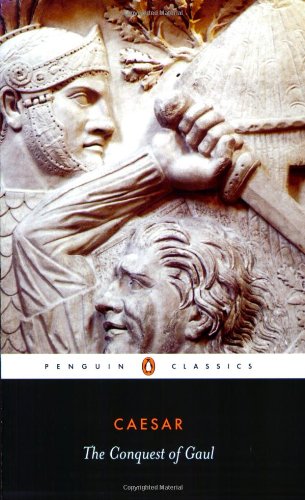
Quote of the month: Julius Caesar

If I would tell you, dear reader, that the quote of the month will be "veni, vidi, vici", I'm sure you'll react with exasperation. Isn't it the very epitome of a worn-out cliché? It certainly is. In addition, it's almost unbearably theatrical. But let me just ask you a single question: why the "vidi"? Why did Caesar stress that he "saw"?

Let me offer you one more quotation. Here is Caesar again, describing his victory in a sea battle over the Veneti:
After that it was a soldier's battle, in which the Romans easily proved superior, especially as it was fought under the eyes of Caesar and the whole army, so that any act of special bravery was bound to be noticed... (The Conquest of Gaul, Penguin, 1982: 80)
Similar passages stressing the inspiring effect that Caesar's gaze has on his troops abound in The Conquest of Gaul. Just to take one more example, here he describes how he manages to turn around a difficult situation during the battle against the Nervii simply by showing that he's looking at his soldiers: "His coming gave gave them fresh heart and hope; each man wanted to do his best under the eyes of his commander-in-chief, however desperate the peril" (ibid. 69).

We can also note that the ability to "see" can be delegated to commanders lower in rank. In one passage he recounts a speech that Labienus, one of his generals, held to his troops before a battle: "Fight as bravely under me as you often have under the commander-in-chief; imagine that he is here, watching the battle in person" (ibid. 137).

Passages like these show Caesar's awareness of the importance of his gaze. But why is the gaze important? Here it is easy to recall the so-called Hawthorne effect. It's well-known that this effect was discovered in the course of a series of observations conducted at a factory where the researchers experimented with changing one condition after the other (lengthening and shorting working hours, increasing and decreasing the number of breaks, increasing and decreasing pay etc) to see what the effect on worker productivity would be. To their consternation they discovered that productivity increased no matter what changes they introduced. The solution to the riddle, they realized, was that the productivity increase was an effect of being observed. It was the workers' response to the presence of the researchers and the attention the latters paid to them. As the sociologist Johan Asplund points out (in his book Det sociala livets elemäntära former), the workers were simply following their human nature in being socially responsive. It's simply natural to humans to respond to the presence of others and their actions. The inspiring and energizing effect that Caesar's gaze had on his soldiers seems to be of exactly the same kind as the effect that the gaze of the researchers had on the factory workers.

What Caesar directs our attention to is, furthermore, the relation between seeing and ruling. In the many passages where he emphasizes the importance of seeing, he seems, implicitly, to be saying that a central functions of the sovereign (or a place-holder of the sovereign, such as a general) is to be the one who sees. Why is this a central function of the sovereign? This, it seems to me, is related to the fact that the sovereign must also be the one of upholds and guarantees the "public" or "official" side of society. To impersonate the sovereign is to be the one who, by seeing, is capable of endowing an act with official recognition and making it public, thereby rescuing it from oblivion. Again and again, in passage after passage, Caesar rehearses this role. Being seen by Caesar, the act is lifted up from the anonymity of merely private existence and granted a kind of immortality. Why immortality? Since the sovereign, as Kantorowicz points out, has "two bodies" - one that human and mortal and another that is divine and immortal. Here we shouldn't let the language of the "sovereign" in singular mislead us. Even in democratic states lacking individual rulers, the "place" of the sovereign exists, as Lefort points out. Wherever we find anyone trying to monopolize the function of being the one who sees, we are witnessing someone aspiring to fill this empty place.


Saturday, 27 February 2016

Quote of the month: Musil

I will try to post, once a month, a quote from my recent reading that I find to be interesting or delightful in some sense. Each quote will be accompanied by a brief, unambitious comment where I try to explain what struck me about it.

My first quote is from an essay by Robert Musil:
I recall a saying of Goethe’s that made an odd impression on me some years ago. It runs: one can only write about those questions one does not know too much about. (Robert Musil, Precision and Soul, The University of Chicago Press, 1990:31)
This seems psychologically true. My first thought on reading it was that it would be an excellent motto for my blog. I've always thought that a blog should be a place where people are free to write in an unpretentious fashion about anything without having mastered the subject. At the same time, a blog should help thought onwards, towards a state of better knowledge. Lukács once described the mood of the essay as longing for an idea not yet born. The same, in my view, can be said of the blog.

What is amazing about good blog texts and essays is that they seem to move with a precision that stems from their fidelity to the movement of thought itself. This precision can make these forms very satisfying intellectually, despite the unpretentious nature of the genre. The reason for this, I feel, is that these forms seem to imply, as a sort of convention of the genre, a recognition of the latter's limitations. To write an essay or blog is to admit that you lack knowledge, and that gives these genres an air of intellectual honesty that is missing in more pretentious genres, such as treatises, reports or academic articles.

My second thought was indeed that the quote also illustrates very well why so much academic writing feels false or irritatingly superficial - especially today when academics are rewarded more for their amount of publishing than anything else. A rather strong argument could be made, I think, to the effect that academic writing per se privileges superficiality. To a great extent this is a consequence of the reliance of academic disciplines on specific sets of methods. Method, I once wrote, is a tool for blinding oneself to relevant information. Although that may have been an exaggeration, I still think that one of the primary functions of method is to sort away information and relieve researchers from having to take the complexity of real, concrete situations into consideration. Method, to put it in a nutshell, is a tool for liberating researchers from the kind of knowledge that would be an obstacle for their writing.

Essays are method-less writing. To the extent that researchers need to "publish or perish" and to the extent that publishing requires them to adhere to certain specified methods, this leads to an exclusion not only of certain forms of knowledge, but also of researchers interested in pursuing such forms of knowledge, and of genres - such as the essay - suitable for such pursuit.

My third thought was perhaps not so much a thought as a kind of mental note of the delightful cascade of questions which the quote triggered in me. Would it be possible to generalize Goethe's statement somehow? Might one, for instance, say that whatever is written is unfinished? Would the statement also hold for other activities? Is it also impossible to speak or think about things one knows too well?

These questions, needless to say, can only be dealt with if I first clarify why the statement seems to ring true. The answer that I find most convincing is that writing is never just a way to approach truth, but also at the same time an act that distances you from it. Say that you jot down a sentence, trying to capture the essence of a thing. Even if the sentence elucides part of the truth, it simultaneously sidelines or excludes other aspects of it. Reluctance to engage in such exclusion seems to be the reason why familiarity with a subject can be an obstacle for writing. Since you don't want to shunt aside anything that is essential - part of the truth - writing in effect becomes impossible.

The most common way to avoid this problem is undoubtedly to keep one's knowledge superficial, for instance by relying on methods.

But aren't there ways to write while doing justice to truth? For instance, how about if we shift from a monological to a dialogical concept of truth? The problem concerning the inability of writing to capture or transmit knowledge seems to arise above all when the writer is a single person trying to present a coherent account from a single perspective, in a single 'voice' so to speak. With Bakthin we might suggest that the form of the novel - especially in its most developed 'dialogical' or polyvocal form, as seen in Dostoevsky - is one possible solution to the problem.

But is it possible to introduce dialogical forms in other genres than the novel? It seems to me that this is a question addressed by both Benjamin and Adorno, even though they don't use the word dialogical.

Adorno, for instance, explicitly rejects the attempt to capture a subject through a single voice or perspective. It requires a plurality of mutually incompatible vantagepoints which come together in a "constellation" of concepts that, rather than attempting to subsume the subject, circle around it, unlocking it through a combination rather than through a single key. A similar idea can be found in Benjamin, who likens such constellations to spider webs for capturing ideas.

How should one end an essay or a blog-post? Can they ever be ended? Almost by definition they preclude conclusions. Perhaps the best way to end them is by returning to the beginning.


Friday, 31 July 2015

The Boy and the Beast - and the claustrophobia of Shibuya

The Boy and the Beast (or Bakemono no ko in Japanese, dir. Hosoda Mamoru, 2015) left me feeling dejected and low-spirited at the end, despite the happy ending. Why?

Ok - det story first. The nine-year old boy Ren is full of resentment against the world after his mother's death and runs away from home to live as a street kid in Shibuya. Trying to escape the police, he loses his way and ends up in the supernatural world of the bakemono (monsterlike beings portrayed as mixtures of animals and humans) that exists in parallel with the normal, human world. In contrast to grey, murky Tokyo, the bakemono world is a sunny and magnificently beautiful pre-modern town. Significantly, while Ren is isolated and surrounded by anonymous masses in Tokyo, in the bakemono world he is constantly talked to and talking back. The bakemono world is a world of communication and human contact.

Ren becomes the disciple of Kumatetsu, a bearlike bakemono who is strong but uncouth and short-tempered. Ren - who is now known as Kyûta - settles down in Kumatetsu's untidy house where they spend their time quarrelling and scolding each other. "Grasp you inner sword!" (Mune no naka no ken o nigirunda), Kumatetsu shouts at the bewildered Kyûta, who doesn't know what to make of this strange injunction and simply shouts back at his teacher. Despite Kumatetsu's inability to provide intelligible guidance, Kyûta grows into a skilled fencer by imitating him. Meanwhile, two friends - the pig-like Buddhist monk Hyakushûbô and the monkey-like Tatara - help educate the boy. As Kumatetsu becomes a father-figure for Kyûta, he himself develops a sense of responsibility, becomes a more skilled teacher and acquires more disicples. When Tatara admiringly talks about how skilled Kyûta has become as a swordsman, Hyakushûbô says that Kumatetsu has grown too: "It's hard to tell who is the master and who is the disciple".


As Kyûta becomes a teenager, the film's atmosphere changes, much of the playfulness disappears and the stage shifts back to Shibuya. Kyûta finds his way back to the human world, where he meets a kind girl, Kaede, who teaches him to read. While discussing Moby Dick she tells him that the whale is not evil in itself - the evil is just the projection of Ahab's own hatred. Kaede is a very proper girl - a trait shown when she asks a group of noisy teenagers to leave the library (later Kyûta has to help her since the teenagers wait outside the library to take revenge on her). Kyûta also manages to find his dad. He decides to leave the bakemono world, but in a fit of rage he runs away from his dad and in the night he meets a terrifying apparation with a black hole in its chest. He realizes that it is himself and that the hole is the inner "darkness" which the bakemono have told him that all humans develop. When he finds Kaede, she manages to calm him by giving him a red ribbon which she says was a bookmark from a book that she loved as a child.

Meanwhile, the time has come for Kumatetsu to face his rival, the equally strong, boarlike bakemono Iôzen. The fight takes place in full public view in a gigantic arena and will determine who will be the next leader (sôshi) of the bakemono. The present leader, a rabbit-like bakemono, has decided to retire and become a god or kami. In contrast to the Kumatetsu, Iôzen is a wellbred, aristocratic figure who is popular with the crowd, has many disciples and lives in an elegant residence surrounded by a bamboo forest. Kumatetsu is on the verge of losing when Kyûta comes back. His spirits raised, Kumatetsu defeats his opponent but is then pierced from behind by a flying sword that is controlled by Iôzen's human son Ichirôhiko – who until now has concealed his humanity but who like all humans has an inner darkness in the shape of a terrifying black hole - and only barely survives. Kyûta and Ichirôhiko meet for a final battle in Shibuya. Ichirôhiko transforms himself into a seemingly invincible flying whale, but Kyûta defeats him with the help of Kumatetsu, who decides to sacrifice himself in order to become an "inner sword" that can fill up the hole in Kyûta's chest. Instead of killing his enemy, Kyûta gives him the red ribbon that he himself had gotten from Kaede. The end is happy – Kyûta is celebrated by the bakemono, gets his girlfriend, reconciles himself with his dad and Kaede persuades him to start studying at a university. He quits fencing but continues to carry his "inner sword" for the rest of his life.


To me, this ending left a bad aftertaste and even a kind of claustrophic feeling. Firstly, part of this feeling comes from the use of "Shibuya" as a metonym for the human world, or at least for the human world as experienced by Japanese youth. Here is certainly the place to ask: who is excluded by the use of such metonyms? Shibuya, for those who don't know, is a popular shopping and entertainment district in Tokyo which is a centre for youth fashion and culture. Unlike, say, neighboring Shinjuku, it is a place that produces the impression of a world divorced from work and from problems related to aging. It's a place above all for young people with money to spend.

Secondly, the film is so preoccupied with the "inner darkness" of Kyûta that not much attention is paid to society. It seems to find nothing wrong with the mainstream society of which the young rebel ends up becoming a well-functioning part.

But if there is nothing wrong with "Shibuya", what then is the need for a parallel world? After all, the function of such worlds in fiction has usually been to address some deficiency in the real world. What is it that the bakemono world offers Kyûta that cannot be found in "Shibuya"? The answer is: an object with which to fill up his "inner darkness". When Kumatetsu turns himself into an "inner sword" he becomes such an object - an introject in the form of a father figure. Is a "father" then what is lacking in "Shibuya"? The preoccupation with fathers in the film is rather startling considering that, biologically speaking, it is not the father but the mother that Kyûta is missing. In present society, the film seems to say, "fathers" are missing despite the presence of biological fathers, and that's why Kyûta needs to travel to the parallel world to find a non-biological father.

Why is it a father - Kumatetsu - that Kyûta seems to need and why not a mother? A look at the role of women in the film shows that it is caught up in traditional gender stereotypes: fighting is the business of men, while women are associated with literature, healing and the power of love. Kaede is not an unimportant figure - she is the one who provides Kyûta with an ideal of to strive for in life and steers him back into mainstream society - but she depends on Kyûta for protection both against bullying teenagers and against the rampaging Ichirôhiko. It is also significant that she is part of the human world, not the bakemono world, which is overwhelmingly masculine. What the latter world provides is a place where boys can grow into "men" in an unabashedly traditional sense, a place where they can be real fighting men. Such places, the film seems to say, are missing in today's mainstream Japanese society. At this point, the suspicion arises that the bakemono world may  be a code for the criminal underworld. That would explain a lot of things - not just the prominence of violence and katanas, but also the central role of masculinity.

At the same time, the film does not one-sidedly affirm this masculine, martial world. Instead, it operates with an idea of a reconciliation between the masculine and the feminine. This reconciliation comes about through Kyûtas's successful socialization, which enables him to unite the best of the bakemono world and the human world - the fighting spirit of Kumatetsu and the gentleness and orderliness of Kaede. We can note in passing that orderliness plays an important structuring role in the film. While there is a good, attractive disorderliness - symbolized by Kumatetsu - this disorderliness has to be overcome (an act symbolized by Kyûta's cleaning up of Kumatetsu's untidy house and Kumatetsu's own development into a responsible father figure). Even worse is the purely evil disorderliness symbolized by the noisy teenagers in the library and their bullying of Kaede - a disorderliness that, unlike Kumatetsu's, is unredeemable and must be subdued by force. On the other hand, there are also "good" and "bad" forms of orderliness. While Kaede stands for the good variety, Iôzen stands for the bad - an orderliness that looks splendid from the outside but that coxists with arrogance. What the film does is to unite two "goods" (Kumatetsu and Kaede) while rejecting two "bads" (the teenagers and Iôzen). The union of the goods (the "complex term" to speak with Greimas) is symbolized by the "inner sword" which enables Kyûta to preserve his fighting spirit even as he adapts to mainstream life, while the union of the bads is personified in Ichirôhiko who wrecks havoc with the world out of resentment at seeing his admired father fall victim to the plebeian Kumatetsu.

Let me now return to the setting. There are works of fiction in which the idea of a parallel world is deployed above all for escapist purposes. That is not necessarily bad, since in such works there is at least an awareness that the real world which one is escaping is not perfect. This film is not an escapist work. It recognizes that problems exist in real society - such as the lack of father figues - and attempts to portray how a possible resolution or reconciliation might look. This, however, is where the feelings of claustrophia set in, because the reconciliation is too premature to have persuasive power. It happens on a purely individual level, through Kyûta's coming of age, without the rest of society having to change one iota. The film seems to want to say: I don't want to change society, only to help you become harmonious parts of it - and my solution is to offer you a sojourn to a world of human contact, where you can develop with a father figure as a model, try out your powers under the surveillance of benevolent adults and establishes ties of friendship and love that allow you to realize the importance to responsibility. It's a little bit like an NGO that seeks only to help delinquent youngsters to "return to society" (shakai fukki, as it is known in Japanese) without breathing a word of criticism against the society it returns them to.

This subservience to mainstream society is what makes the film so different from, say, Miyazaki Hayao's Spirited Away (Sen to Chihiro no kamikakushi), which similarly portrays a young child who finds her way into a supernatural parallel world in which she has to go through a number of trials in order to return to the human world. In Miyazaki's film there is nothing that suggests that Chihiro's adventures in the other world will make her a harmonious part of mainstream society. Quite to the contrary, her stay in the other world opens up her eyes to wrongs performed by humans, such as pollution and the destruction of rivers. There is even a suggestion of a critique of capitalism in the film's portrayal of Kaonashi, who seems to believe that money can make up for the absence of friends, who starts to devour people, and whose appetite only grows the more he devours - a metaphor for endless capital accumulation. Chihiro's adventures in the other world seem almost like a training for the struggles she will have to fight in the future to rectify the human world. In Spirited Away, then, the parallel world is deployed as a device for groping for ways to overcome the real social ills without the film portraying the reconciliation as already achieved.

Capitalism?
That The Boy and the Beast ultimately reduces the bakemono world to a kind of service station for the injured young hearts of the human world amounts to a spectacular castration or devaluation of the idea of a supernatural parallel world. Instead of threatening or destabilizing the human world, it is given a purely supportive role as a place for healing teenage hearts and helping them onwards in life on the road to becoming good members of society who like to read books and study at the university. Here, I think, is the explanation to why the happy ending doesn't feel happy. Surely, Kumatetsu would have deserved better than to be a mere catalyst of Kyûta's successful socialization into mainstream society.

The harmony between "Shibuya" and the bakemono world also suggests a nationalistic idea, namely that despite its modernization, Japan is still a "land of the gods" - that beneath the everyday, grey surface, it is still a glorious and colourful land of supernatural beings who stroll about with katana. According to this idea, Japan has not lost its national essence, which lives on in the hearts of young Japanese, just like Kumatetsu lives on in Kyûta's heart in the shape of an "inner sword". As Spirited Away shows, the idea of a "land of the gods" can be given an inflection that turns it into a criticism of the state and of capitalism. This can also be seen in historical phenomena such as the Ee ja nai ka-movement or the idea of a rectification of the world (yonaoshi) that informed many of Japan's millennarian movements. This, however, should not blind us to how often the idea of the "land of the gods" has been mobilized to prop up the legitimacy of the state, the emperor or of mainstream society. Dear Hosoda Mamoru, couldn't you please have moved away a little further from that latter legacy?

Saturday, 9 May 2015

The pleasure of destruction: Godzilla and other things that come from the ocean

In this post I want to focus on the role of the sea, especially the vast expanse of sea stretching out in a south-eastern direction from Japan, as a screen for utopian as well as dystopian projections in Japanese popular culture.

A good place to start is Godzilla - not the new movie from last year, though, but the original one from 1954. In these post-Fukushima times, it's easy to understand the enormous impact this movie must have made on the audience when it was released, resonating, as it does, with the fear of radioactivity, memories of the war and at some level also with an ancient dread for the sea itself as the birthbed of tsunamis and typhoons.

"Irane" (No thanks), a print by Inaba Tomoko in the wake of the "triple" diaster 2011  
It is well known that this original Godzilla movie is littered with references to the war (see Igarashi 2000, Napier 1993). The monster is awoken by US nuclear tests in the Pacific. Its attacks on Tokyo replicate the destruction wrought on the city by the American air raids. The Japanese military is totally powerless to stop it. People run for shelter to the sound of air raid sirens. It razes buildings symbolic of power to the ground, but - like the Americans - leaves the imperial palace intact. In an interview, the director Honda Ishirô later stated that the destruction had been modelled on the March 1945 fire-bombings of Tokyo. That the monster was a thinly veiled reference to the former enemy is also clear from the fact that the film opens with a scene that in a shockingly direct way alludes to the Lucky Dragon incident, showing a Japanese fishing boat suddenly overpowered by a mysterious force emerging from the sea. This incident had taken place earlier in 1954, when a Japanese fishing boat had been showered with radioactivity from a US hydrogen bomb (despite being outside the putative danger zone), leading to the death of one of the crew members a few months later. But is Godzilla really a stand-in for the enemy? In another memorable statement, the film's music director Ifukube Akira, said: "I even thought Godzilla was like the souls of the Japanese soldiers who died in the Pacific Ocean during the war". Here too the reference is to the war, but the monster is seen as an incarnation of Japanese soldiers, who, in the fashion of vengeful ghosts, return to haunt and kill the survivors.

Godzilla
So is Godzilla less an enemy to subdue than a ghost to be placated? In any case, Godzilla is more than a thinly veiled fleet of American bombers. Recall the scene early in the film when the first rumours of something strange at sea are starting to circulate. An elderly fisherman says, with tremour in his voice, that "it might be Godzilla" (Gojira ka mo shiranee) and explains that in the old days human sacrifices had been needed to pacify the monster. Later, during the stormy night when Godzilla first wades ashore, the villagers perform a religious ritual involving dancing and tengu-masks, presumably in order to placate the monster. Here, obviously, Godzilla is treated as a form of god-like being or kami associated with the sea.

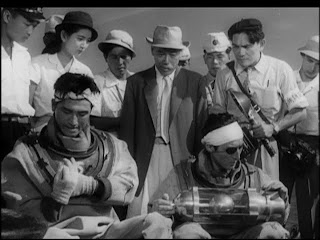
The fact that Godzilla resonates with religious traditions may at first seem surprising considering the central role of science in the movie. It is modern science in the form of nuclear bombs that awakens the monster. The main protagonist is an aged scientist, Yamane Kyôhei (played by Takeshi Shimura). In the end, it is also science in the guise of the "oxygen destroyer" invented by the young scientist Serizawa that subdues the monster. Susan Napier also highlights the role of science in her interpretation of the film, which allows for a happy ending by letting "'good' Japanese science triumph against the evil monster". The film, she writes, belongs to the fundamentally optimistic genre of "secure horror" in which order is "ultimately reestablished, usually through the combined efforts of scientists and the government" (Napier 1993:332). But this interpretation is hard to square with the fact that Godzilla reenacts the trauma of the war: surely science is a flimsy and fragile protection against the force of trauma. If the "deeper" problem addressed by the film is related to the war and the guilt associated with it, then science is certainly not the recipe. Furthermore, viewing science as the savior overlooks the fact that what subdues Godzilla is not just science but also a human sacrifice, namely that of Serizawa himself, who, instead of returning to the surface after having delivered the oxygen destroyer at the bottom of the sea, chooses to cut off his air-hose in order to die together with the monster. This suicide clearly enacts the very ritual - the human sacrifice - mentioned by the old fisherman earlier in the movie. Science then is not the solution, but merely the camoflage or alibi of the real solution, the resurrection of ritual by other means. Ritual becomes a means of atonement, a way of addressing the lingering grief and guilt associated with the war. The monster becomes the place-holder of the trauma that has to be placated. "Never again", Yamane says, echoing what today has become the formula for addressing the horrors of the war. But his prophesy that new Godzillas will be born as long as the bomb tests go on reminds us that the task of finding a reconciliation with the past is not over. 

Serizawa's sacrifice
Godzilla embodies destructive forces associated with the sea, forces that both evoke the Pacific War and forces of nature such as typhoons and perhaps earthquakes that in old times were addressed in religious language. But what is the significance of the sea in this movie? That the sea is in fact central to it is suggested by the fact that it plays a similar role as an abode of monsters or supernatural beings in many other works of popular culture.

Take for instance Neon Genesis Evangelion, the celebrated anime series from the mid-90s, where monstrous "apostles" (shito) mysteriously hatch in the ocean and compulsively wade ashore in Japan to wreck havoc in a seemingly endless succession. At once we can notice the similarity of the geographical route taken by Godzilla, which in turn, as we have seen, repeats the route of the US forces in the war. Like in Godzilla, there is also a striking tendency to "quote" war-memories, as in the bisarre naming of several principal characters after WWII aircraft carriers. As Sawaragi Noi suggests, it is easy to read the apostles - who form a cross when they blow up - as a symbol of the US or the West, and the endless row of battles therefore as a traumatic repetition of the desperate last days of the Pacific War. At the same time, there are many things in the weird setting - for instance the fact that the Evas (the gigantic robot-like machines used for battling the Apostles) have to be driven by children - that only make sense if we view the film as not really being about the struggle against an external enemy but rather as an imaginary reproduction of an inner psychic traumatized space in which two impulses compete: on the one hand the death-drive or the urge to repeat the trauma - a drive symbolized by the relentless Apostles, who seem to lack all consciousness and attack blindly - and, on the other hand, the budding impulse of recovery and consciousness, symbolized by the small kids locked up in the gargantuan mecha-shells who have to fight the death-drive. The big difference to Godzilla is of course that Neon Genesis Evangelion is a far more "anomic" film, a film that depicts a world in which the terrifying psychic/supernatural forces can longer be brought under control. There is no longer any ritual - in the style of Serizawa's sacrifice - that can contain them.

Apostle approaching from the sea
The importance of the sea here resides, I think, in the fact that it helps us compare movies like Godzilla and Neon Genesis Evangelion - movies that appear to have a lot in common but which nevertheless differ in interesting ways. The sea can play this role because of its persistent association with the supernatural. The supernatural forces associated with the sea do not necessarily have to be monstruous. Recall for instance the arrival on a of the "myriads of gods" (yaoyorozu no kamigami) to the bath-house in Sen to Chihiro no kamikakushi (Spirited Away). The gods arrive on a paddle-streamer, hailing from a glittering city on the other side of the water:


The arrival of the myriads of gods
This reminds us that the sea is also Japan's utopian direction - the place of Tokoyo, the happy, green land of immortals or the dead which was pictured as existing far out in the ocean or on the other side of the sea. Tokoyo could also be pictured as a land of gods, as in the Okinawan idea of Nirai Kanai, from which the gods would periodically come to visit the human world. Japanese etnographers like Orikuchi Shinobu and Yanagita Kunio have written famous works on this belief. The former based his theory of marebito (visiting gods, or "rare visitors") on it, while the latter discusses the various ways in which it was linked to a view of the ocean as a bringer of gifts and blessings in his late work Kaijô no michi. Probably this belief in gods arriving from the sea is also connected to the idea of the Dragon Palace (Ryûgû) under the sea where the god or goddess of the sea was supposed to live. This palace appears already in the Kojiki myth about Uminosachi where it is said to be the dwelling of Watatsumi, the sea god. The chronicles Kojiki and Nihongi also contain other myths that describe gods arriving from the sea such as Sukunahikona or Hiruko/Ebisu. The most touching of these tales is probably that of Hiruko (the "leech-child) who was deformed and put out to die in a boat of reeds, but who - according to one variant of the myth - was taken care of and healed in the Dragon Palace and later returned on the back of a wani (a form of sea monster) and became worshipped as Ebisu, protector of fishermen and one of the "lucky gods". In parts of Japan there was a belief that the Buddha of the future, Miroku, would arrive on a ship from across the ocean. Similar ideas can also be found in the Chinese legends about islands like Peng-lai or Fusang which were thought to be located in or floating around in the Eastern Sea and which were also associated with immortality and eternal youth. It is not farfetched, I believe, to see an echo of these mythological beliefs in the motif of the seven lucky gods on their "treasure ship" (takarabune) which become popular in Japan from the Muromachi period onwards.

Ebisu, Daikoku and the other lucky gods in the treasure ship

The last great historical moment when these beliefs fuelled popular Utopian expectations on a large scale was probably in the wake of the Ansei Earthquake in 1855. As the historian Gregory Smits points out, the destruction became linked in the popular mind with the arrival of Perry's "black ships" the year before. A large number of woodblock prints (so called namazu-e) exists from these years that depict the gigantic subterranean catfish (namazu) that was thought to cause earthquakes. Many of these prints depict the catfish together with one of the lucky gods, Daikoku, who has a wonderful hammer (uchide no kozuchi) which showers gold over the common people. The message of these woodblock prints was clearly subversive since they called for yonaoshi - "rectification of the world" - which implied the redistribution of wealth. Smits makes a point of the fact that the giant catfish was usually depicted as big and black and that the name Daikoku literally means "big black". In the prints, these two "big blacks" were in turn linked a third, namely Perry's black ships.

Daikoku and the catfish

The catfish forces the rich to throw up their money
Does this rich flora of myths and folklore tell us anything about Godzilla? Well, let us try, as a thought experiment, to map these ideas on film monster and see what we get. I have already suggested that Godzilla can be seen as an incarnation of the trauma of war. Could it also be seen as Ebisu? As a "rare visitor" (marebito) who brings blessings, utopian energies, and the possibility of a renewal or rebirth of the world?

Maybe this is not so farfetched as it may sound. Godzilla, after all, is an ambivalent creature, not so much a mere external enemy to be destroyed as a catalyst of our own inner process of coming to terms with a painful past. In later films, it even takes on the role of defending humanity against other invading monsters, becoming, in effect, a kind of benevolent deity. The sea too was never regarded simply as a bringer of blessings, but was also, just like the monster, a source of destruction, of typhoons and tsunamis. To really grasp the utopian side of Godzilla, however, we need to hold fast to the deep pleasure of destruction itself. This pleasure is well expressed in the following quote:
"Godzilla appeals to that destructive instinct that’s in all kids," says Takeshi Maruyama, a 28-year-old "salaryman," who grew up on the VS series and has an extensive Godzilla figure collection. A lot of buildings were constructed while Maruyama was growing up, a period for Japan’s "bubble era" modernization. And it was a delight to see Godzilla destroy them almost as soon as they went up, Maruyama recalled. One of his favorites is "Godzilla Vs. Mothra," released in 1992, which showed his hometown of Yokohama destroyed, including Land Mark Tower, one of this nation’s tallest buildings, which was being built as the movie was shot. "It is so fun to see a giant thing break and get totally destroyed," he said. "You can’t explain it in words. You just feel it in your heart, and it’s so immediate." (Kageyama 2014)
What is this pleasure? To understand it, we might compare to how the Neo-pop artist Murakami Takashi welcomed the collapse of the "bubble economy" in the early 1990s. Comparing the bubble to a maniacal feeling of having conquered the world, he writes that “when that mirage vanished, we felt relief, as if to say: ‘That’s right, this is what reality looks like’” (Murakami 2005:135). This sentiment was echoed by the philosopher Karatani Kôjin, for whom the collapse was a breath of fresh air. Looking back in 1997, he writes that he had “felt almost suffocated in Japan during the 1980s”, when people were euphoric and Japanese capitalism seemed triumphant (Karatani 1997).

There is, I think, a moral dimension to the pleasure expressed in these quotes, which can be expressed as pleasure at seeing justice done. It is relief at the disappearance of something that is not just suffocating or oppressive, but that by rights should not exist. Here is the place to quote Kafta, who ends one of his stories ("The City Coat of Arms") with the following words: “All legends and songs originating in this city are filled with nostalgia for a prophesied day when the city would be smashed to bits by five blows in rapid succession from a gigantic fist.” Expressed in these words is the pleasure of the apocalypse, of divine force levelling the human world. A similar pleasure is, perhaps, also typical of revolutionary moments. A new world has always required a settling of accounts with the old one. Talk of yonaoshi (rectification of the world) was in fact feared by Tokugawa officials much as the talk of revolution has been feared by elites in the modern world.

Is Godzilla then linked to revolution? Well, it is certainly linked to the desire to erase wrong. The reason that the monster is not simply a fearful external enemy and that there is something pleasurable about the destruction it causes is that the "ghosts" that it embodies are right. The destruction is felt to be rightful and well deserved. As James Berger (1999) points out, the desire for the apocalypse is always a desire for a second catastrophe that will set things right that went wrong during the first one.

The monsters appearing in films like Godzilla and Neon Genesis Evangelion point back to earlier, prior catastrophes that are still not properly acknowledged and atoned for by those responsible for it. The catastrophe of war, perhaps, in which countless people were sacrificed for the nation or the emperor, or the ravaging of nature, or the exploiting of people for the profit of others. These catastrophes have a traumatic quality since the "wrong" that needs to be righted is not just external, but committed by the communities with which "we" identify or the systems that benefit "us". Unlike in the usual enthusiasm for revolution, the trauma calls for the destruction, not of an external enemy, but of ourselves. This is why, at first sight, these monsters appear as vengeful ghosts that won't go away until they are placated, until we apologize properly, until we have found a way to make up for our wrongs. Until that happens, the monsters will reappear and the cities and skyscrapers will continue to be toppled over and destroyed.

Trauma, I suggest, is suppressed revolutionary desire - it is the guise taken by such desire when it cannot be acknowledged by the ego. It is revolutionary in its merciless accusation against the present and in its insistence that justice be done, but at the same time it is suppressed because the ego is unable to acknowledge its own destruction. The trauma calls for the ego to stop identifying with what needs to be destroyed. Freud stresses that the traumatized person actively desires to repeat the trauma. Importantly, this is not just a symptom of the trauma but also part of the process whereby it can be mastered. By repeating it actively, out of its own volition, the ego turns itself from a passive victim into an active agent, and thereby gradually makes the trauma acceptable to consciousness. This can be seen as a process whereby we acknowledge the right of ghosts - as a process whereby we move towards the standpoint of the ghosts and thereby resurrect them, lend them life, as part of ourselves. The working through of a trauma is not a mere inner process, but a transformation whereby we commit ourselves to changing the world into a better one in which the ghosts will not have died in vain. As we repeat, we learn to avoid the "wrongs" of the first catastrophe and, if we learn well enough, not only the ghosts but we ourselves will spring back to life. The pleasure of destruction doesn't just spring from cruelty. Another dimension is the feeling of recovery, or, as Karatani puts it, that we become able to breathe again. 

As I think I've shown, destruction in Godzilla is linked at least indirectly to a form of Utopian imagination. Looking at the list we have assembled so far of the monster's incarnations, we find: the American bombers, the souls of dead Japanese soldiers, the god of the sea, the rare visitor, Ebisu and Daikoku, the giant catfish, and maybe Perry's "black ships". Which one of these incarnations will come to the fore when we watch the movie will depend on our interpretation. When facing Godzilla, we should perhaps ask ourselves, as we should whenever we meet a human being: this person has immense potential both to do me harm and to bring me happiness - what will it be? Will it be both?

The pleasure of destruction


References.

Berger, James (1999) After the End: Representations of Post-Apocalypse, Minneapolis, London: University of Minnesota Press.

Igarashi, Yoshikuni (2000) Bodies of Memory: Narratives of War in Postwar Japanese Culture, 1945-1970, Princeton: Princeton University Press.

Kageyama, Yurika (2014) “Japanese fans speak on evolution of 'Godzilla'”, Japan Today, 28 July 2014; http://www.japantoday.com/category/arts-culture/view/japanese-fans-speak-on-evolution-of-godzilla (accessed 2014-07-28):

Karatani, Kôjin (1997) “Japan is interesting because Japan is not interesting”, lecture delievered in March 1997, reproduced on Karatani Forum: www.karataniforum.org/jlecture.html (accessed on 2002-11-19).

Murakami, Takashi (2005) “Earth in my Window”, pp 98-149, in Murakami Takashi (ed) (2005) Little Boy: The Arts of Japan’s Exploding Subculture, New Haven: Yale University Press

Napier, Susan (1993) “Panic Sites: The Japanese Imagination of Disaster from Godzilla to Akira”, Journal of Japanese Studies 19(2): 327-351.

Smits, Gregory (2006) “Shaking up Japan: Edo Society and the 1855 Catfish Picture Prints”, Journal of Social History 39(4): 1045-1078.

Yanagita, Kunio (1978) Kaijô no michi (The ocean roads), Tokyo: Iwanami.