Monday, 9 February 2015

Newtypes: ideology and utopia in Gundam

Multidimensionality in a work of fiction is pleasant. It also helps generate a sense of reality. The sense of reality is generated in the unpredictable relation between a plurality of dimensions along which conflicts can be played out. Unpredictability is a key element here. A reality without surprises would neither feel real, nor arouse our interest. If reality can never be fully known, then what is known can never be felt to be fully real.

At the same time, the tension between dimensions generates ideologies. Ideologies are attempts to combine, in an "impossible" synthesis, the diverse and contradictory longings embodied in and played out along different dimensions. Borrowing a formulation from Fredric Jameson, they are ideal solutions to real contradictions. Because they are grounded in a real longing to solve or surpass the contradictions, they also contain a utopian element that points beyond them. Sparks of utopia reside even in the most ideological works.


Liberalism and fascism

For an example, let me turn to Mobile Suit Gundam, the classical Japanese anime that was aired  as a TV series in 1979 and reedited for theatrical release in 1981. The setting is the war waged between the Earth Federation and one of its breakaway colonies, called Zeon. Zeon is initially successful, achieving great military victories and wrecking havoc with the earth. The Earth Federation, however, manages to develop a gigantic robot-like "mobile suit" named Gundam. Piloted by a young boy called Amuro, Gundam helps turn the tide of war. 

Statue of Gundam in Odaiba
Zeon is ambiguious in a way that indicates that it lies at the crossroads of several separate axes or dimensions structuring the work. It appears equipped with all the attributes of a prototypical evil foe, such as militarism and authoritarianism. Many of its attributes evoke Nazism. At the end of the first film, during Gihren Zabi's "Sieg Zeon" speech, the grey masses are grouped in endless rectangular formations reminiscent of the Nuremberg rallies and the speaker calls Zeon a chosen people. And the flag of Zeon is a pastisch of the Nazi war flag.
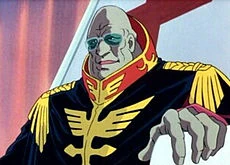
230px-Degwin Zabi (Gundam)
Degwin Sodo Zabi, ruler of Zeon
Unlike Nazi Germany, however, Zeon styles itself as the leader of an anti-colonial war with the aim of liberating earth's colonies. Here the affinity seems rather to be with imperial Japan, which during WWII adopted a pan-Asian ideology according to which Japan would liberate Asia from the colonial yoke and lead all oppressed nations in a global crusade against the white race. There is also much else in Zeon that is reminiscent of imperial Japan. The Musai space cruisers, for instance, are evocative of Japanese wartime battleships with their towering pagodas. Char Aznable, Amuro's main antagonist, wears a helmet that looks like a samurai kabuto.
Lalah Sune and Char Aznable
The Earth Federation, by contrast, seems vagulely modelled on the UN or NATO. This suggests that the central conflict structuring the movie is the one between a liberal Pax Americana-type world order a rising, militaristic fascism. The function of Gundam would then (as its name suggests) be that of a “dam” protecting the earth against the rising tide of fascism. Translating this into contemporary politics, one might say that the filme takes the side of the US-led postwar order against the legacy of the prewar fascist powers defeated in WWII.


Newtypes and oldtypes

Yet the existence of another, even more important axis in the film makes things more complicated. This is the axis along which the conflict between "newtypes" and "oldtypes" is played out. The newtypes are human beings such as Amuro and Char who have developed paranormal abilities due to their exposure to the environment of outer space - abilities that include heightened powers of perception and intuition, increased agility of movement and the ability to communicate telepathically. The newtypes, however, suffer discrimination by the oldtypes, the old humanity on earth. 
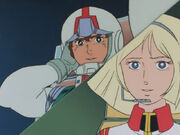
Amuro & Sayla
Two newtypes: Amuro and Sayla Mass
Unlike the Earth Federation, Zeon explicitly embraces the evolutions of humans into “newtypes”. According to a prophetic statement by Zeon Zum Deikun, founder of the Republic of Zeon, "someday mankind would undergo a transformation. Should that come to pass, mankind may give birth to a new race of men who by themselves will rule the universe... What he called a ‘new type’ of human" (quoted in Drazen 2006:175). It is this “newtype” ideology that allows the people of Zeon to conceive of themselves as a racially superior "chosen people".

We can now note an important pecularity with the film that arises from the way in which the "newtype-oldtype" axis intersects with the "liberalism-fascism" axis. Although the film portrays Zeon as a quasi-Nazi dictatorship against which Gundam serves as a bulwark, it accepts an important part of its ideology. In the film, newtypes really exist and have superior abilities. The evolution of humanity prophesied by Zeon Zum Deikun really takes place. It’s a little bit as if an ostensibly anti-Nazi film had portrayed Germans as actually superior to Jews. Or, for that matter, an anti-colonial film in which white actors get all the important roles (not so uncommon, right?).

The film's very structure seems to privilege the newtypes. They are clearly portrayed as the principal players in the war, as the heroes on which the fate of the rest of humanity will depend. Amuro himself is a newtype who grew up on one of the Earth Federation's space colonies and therefore fights on its side. Newtypes thus take part on both sides of the war. All the film's climactic battle scenes depict newtypes flying around in their huge mobile suits fighting each other. The result, as Ian Condry observes, is that the war appears to be played out on an “action-movie scale", the battles hinging on "a limited number of heroes and rivals that hardly characterizes actual wars" (Condry 2013:126). A sense of commonality and even mutual respect seems to exists between newtypes on both sides in the war. Their relations are guided by a kind of warrior ethic which the film seems to endorse. Despite being Amuro's main antagonist, Char is sympathetically portrayed and appears to have been as popular among viewers as Amuro. Indeed, Amuro and Char are portrayed as “two worthy opponents… neither of which is more or less evil than the other” (Murakami 2005:31).
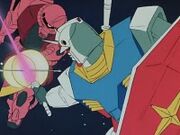

X5 Char and Amuro fight
Amuro and Char
From this point of view, it no longer makes sense to says that the film takes the side of the "liberal" Earth Federation. Instead the "liberalism-fascism" axis is displaced by thes "newtype-oldtype" axis. At this point in the argument it would be possible to visualize the relation between these two axes with the help of a Greimasian semiotic rectangle, but instead of actually drawing it, let me just pose the question of whether anything corresponding to what Greimas calls the "complex term" can be found in the film? In other words, does the film offer any kind of imaginary resolution of the tension between the two axes? The answer here, it seems to me, is Gundam. As mentioned above, it functions as a "dam" protecting the earth. However, being a mobile suit which needs to be piloted by the newtype Amuro, it can only function as such a “dam” by harnessing to itself the powers of space, powers more associated with Zeon than with the Earth. Gundam, then, doesn't represent the liberal order of the Earth Federation so much as the "impossible" desire to protect this liberal order through illiberal forces associated with elitist notions of racial superiority ("the chosen people") and hero worship.


Otaku and new ethnicities

This blend per se is not unfamiliar. One only need to think of Hollywood. How many movies exist that celebrate tough police officers who protect "liberal" America precisely by their readiness to break the rule book? One could also think of Kurosawa, whose films have been described as pervaded by an impossible desire to combine Confucian hierarchy with socialist egalitarianism (Wernström 1996).

But Gundam goes further than this. To appreciate why the film strives to create an ideological synthesis out of the two axes it is necessary to ask why the reigning "liberal" order of postwar Japan on its own is felt to be insufficient or oppressive at least to some groups in Japan. Critics have often linked the “newtype” idea to the otaku subculture. As the renowned pop-artist Murakami Takashi points out, it functions as a subcultural ideology portraying the seemingly sloppy, asocial and abnormal lifestyles of otaku as the seed of a new future humanity with superior abilities. Murakami describes Amuro as “an otaku-like, machine loving introvert who accidentally becomes the pilot of the Gundam; far from heroic… Amuro prefigured the purposeless Shinji Ikari of Neon Genesis Evangelion” (Murakami 2005:31).

This means that rather than rather than an abstract struggle between “liberalism” and “fascism”, the quandary from which the film departs is that contemporary Japan and its youth. The new types who have developed a new sensibility thanks to their adaptation to a new environment are the same as the young generation, living in a new time which they understand better than their parents, yet feeling discriminated and harassed by then as well as by teachers and mass media.

John of Patmos watches the descent of the New Jerusalem from God in a 14th century tapestry.
New Jerusalem 
Elements of a generational conflict are unmistakably present here, but there seems to be more than that. The sociologist Ueno Toshiya suggest that "the difference between newtypes and ‘old human beings’... functions as a stand-in for the difference between races and ethnicities as well as for the difference between classes” (Ueno 1998:138). Building on this, he goes on to interpret the film from what could be called a post-colonial, cultural studies perspective that makes the newtypes similar to what Stuart Hall (1992) and Les Back (1996) refer to as new ethnicities. Words like "Zeon" and "chosen people", in his reading, do not connote fascism but rather Zionism. The latter in turn is an ambiguous ideology, not just referring to the Israeli state ideology but also to the Zion of  reggae and rastafarism - an ideology linked to Etiopia, Pan-Africanism and anti-colonial struggle. This would explain the prominence in the Gundam series of the colonial struggle for independence, the discrimination against the newtypes, the appearance of the word “Cosmo-Babylon”, the fact that so many of the newtypes appear to be "colored" (some like Lalah Sune are dark-skinned, other seem vaguely Chinese), and the prevalence of names of Third World cities which, as Ueno suggests, turns the space of the film into a “pseudo-colonial space” (Ueno 1998:129-137).

By reading the newtypes as "new ethnicities", Ueno affirms the utopian side of the newtype ideology as against its fascist appropriation. Zion is of course a word loaded with utopian connotations - the Heavenly City, the New Jerusalem that will be free from oppression. It would even be possible to read the evolution of newtypes as heading in an angelic direction, with humans growing more spiritual and less limited by their material body.


Amuro
Murakami Takashi offers a darker, more critical reading of this ideology which penetrates deeper into the problems of contemporary Japan. The newtype, he writes, is suggestive of the "savant syndrome" in people with mental disabilities that nonetheless possess astounding memories. He quotes the neuroscientist V. S. Ramachandran’s description of this syndrome: “Consider the possibility that savants suffer early brain damage before or shortly after birth… Is it possible that their brains undergo some form of remapping as seen in phantom limb patients?” (quoted in Murakami 2005: 147). To Murakami, the asocial otaku with their subcultural obsessions are emblematic of postwar Japan as a whole, a country mutilated through the trauma of war and the subsequent loss of independence. In such a country it is no wonder that fantasies of a compensatory development take root. "Amuro", he writes:
...is a shy, antisocial New Type who awakens to war. It is inevitable that humans who are born and dwell in low-gravity space, with radiation levels that far surpass those on earth, will be fundamentally different from humans born and raised on this planet. For the Japanese, the hope that a New Type will emerge in this environment is an inevitability, born of the confluence of reality and postwar trauma. (ibid.)
Murakami's intention is not to criticize otaku culture, but rather to affirm it as a culture of "deformed monsters". From his perspective, it is precisely by identifying as a pathetic otaku in need of the newtype ideology that new possibilities of authentically grappling with postwar Japanese history open up. While this reading helps turn Gundam into a tool of criticism against the postwar Japanese order and superficial nationalist self-images of Japan as a country of refined beauty, a further merit is that it helps bring into view the pain and desperation fuelling the newtype ideology. If his interpretation is correct, it is out of despair at having failed as a normal human that some people simply must hope for the development of compensatory special abilities of the newtype sort.

Ian Condry sheds some light on this desperation in his recent book The Soul of Anime. Here he discusses petitions launched by self-proclaimed otaku for the legal recognition of marriage to 2D characters. He quotes the otaku spokesman Tôru Honda (a.k.a. "the Radiowave Man") who deliberately opts for 2D characters, dismissing those who prefer real people ("3D characters") as being behind the times. “One can read Radiowave Man’s manifesto not primarily as a rejection of relationships with real women but, more imporant, as a defense of failed men”, Condry comments (2013:194). To explain this sense of failure, Condry refers to masculinity studies which explain “why so much otaku-oriented anime contains troubled male protagonists who essentially reimagine the hero as vulnerable, and anything but all-powerful” (ibid.). The apex of this development is Shinji in Evangelion, but the prototype of this sort of male was Amuro. Condry continues that “an otaku perspective on masculinity reminds us of the vulnerability experienced by many men who live outside the dominant ideal of male success” (ibid. 195).

Dameren, a movement for defending failures and for a society in which no-one needs to be a loser
To "save" the newtype ideology in the sense of locating its possible utopian relevance, it is not enough to link it to reggae, as Ueno does. Probably, one must also link it to the “failure” of many young Japanese to live up to the norms of masculinity.  It is the losers’ utopia that is depicted here. The "revolution of good-for-nothings" (dame kakumei) is anonther of its expressions. In the group Dameren (the League of Good-for-nothings), which was active in the 90s and helped lay the groundwork for the precarity movement and other forms of youth activism in Japan today, the ideology is taken in a more progressive direction. Their revolt was against the “old” world that oppressed them, but unlike the otaku they were not asocial. They did their best to nourish alternative forms of living and communicating in their small alternative spaces. They too knew that the failure had to be affirmed in order to create a society in which failing is not so harshly judged but tolerated as something normal and ordinary (for more on Dameren, see my book). But to save an ideology is not simply to affirm it as it is. When Murakami Takeshi wrote that he wanted to affirm himself as a deformed monster, what he was saying was: instead of simply believing in the attractive ideology of new types, we must acknowledge ourselves as pathetic creatures who are attracted by it.


References

Back, Les (1996) New Ethnicities and Urban Culture, London: UCL Press.

Condry, Ian  (2013) The Soul of Anime: Collaborative Creativity and Japan’s Media Success Story, Durham: Duke University Press.

Drazen, Patrick (2006) “The Shock of the Newtype: The Mobile Suit Gundam Novels of Tomino Yoshiyuki”, Mechademia, Vol. 1: 174-177.

Hall, Stuart (1992) ”New Ethnicities”, pp 252-259, in James Donald & Ali Rattansi (eds) ’Race’, Culture and Difference, London: Sage Publications.

Murakami, Takeshi (2005) “Earth in my Window”, pp 98-149, in Little Boy: The Arts of Japan’s Exploding Subculture, New Haven: Yale University Press

Ueno Toshiya (1998) Kurenai no metaru sūtsu: anime to iu senjo (Red Metal Suits – Animation as Battleground), Tokyo: Kinokuniya shoten.

Wernström, Göran (1996) Medvetet/omedvetet och filmberättande: en studie i Akira Kurosawas film Sju samurajer, Lund: Lund University.

Saturday, 20 September 2014

Zatôichi, Yôjimbô and imaginations of power

One of the most memorable scenes of Zatôichi (2003, dir. Kitano Takeshi) is near the end, when the blind itinerant masseur Zatôichi (Kitano Takeshi) in a stroke with his sword blinds the "Kuchinawa boss" (Hiura Ben), saying that death is too good for him. The sense of cruel satisfaction here is, I think, a little bit different from the one produced by the typical action movie endings when the bad guys get what they deserve. Here the sense of satisfaction is mixed up, at least to certain extent, with what could perhaps be called the pleasure accompanying intellectual development. Who is the Kuchinawa boss? Is Zatôichi really blind? Questions like these help build up a curiosity in the viewer that is at least as important as the mere satisfaction in seeing justice being meted out. The scene, then, is not simply there to bring closure to the film by distributing justice, but also to reveal new aspects of the story itself.
 
However, what the ending really illuminates is not so much the personalities of Zatôichi and the Kuchinawa boss.  What it brings into view, in a breathtakingly sudden act of illumination, is a particular image of power. Recall that the Kuchinawa boss is a mysterious existence, whose identity is unknown for almost the entire film. Although suspicions soon arise that he might be associated with one of the two rival gangs fighting for supremacy in the little town, he is clearly not identical with the gang's publicly well-known nominal head, Ginzô (played by great actor and rock band bassist Kishibe Ittoku). Ginzô is seemingly victorious after having crushed the rival gang with the help of a newly recruited yôjimbô, the masterless samurai Hattori (Asano Tadanobu). Zatôichi dispatches Hattori, Ginzô and most other gang members in a climactic showdown and then heads into a dark alley to find Kuchinawa. The film now departs markedly from the realism to which it until then had paid half-hearted lip service. In an almost dreamlike sequence he is attacked by ninjas, the leader of whom turns out to be the town's innkeeper (Emoto Akira) who, before being cut down, proudly declares himself to be the Kuchinawa boss. Zatôichi, however, is not fooled. Guided by unfallible intuition, he continues insides the inn where the innkeeper's henpecked underling, an old man with a crooked back, is waiting for him. He is the real Kuchinawa boss, who has now seen his life work being reduced to rubble. "You are the worst of them all", Zatôichi says. A brief exchange of lines follows, before the old man shows his tattoos and definatly asks his antagonist to cut him down - "Kire!". But Zatôichi's sword, quick as a flash, only cuts through his eyes. "Live your life in blindness", Zatôichi says contemptuously - his eyes nailing the old man to the floor, grey as steel and merciless as pistol muzzles - and then he leaves. Meanwhile the villagers are preparing a matsuri (festival). Everything starts anew, the earth is purified and renewed, the house that was burned down by the gang is rebuilt, and all the actors appear on the stage in a joyous step dance, some dressed in jeans and sneakers - as if bidding farewell to the autidence like at the theatre.

Although these final shots break with "realism", they perform a crucial function in visibilizing a form of power that can be characterized as indirect, multilayered and hidden. Zatôichi's journey through the dark alley is metaphorically a journey to the heart of this power, a journey that is necessary in order to cut off the roots of the corruption pervading the visible everyday world of the town (a corruption hinted at in the name Kuchinawa, "rotten rope", with the additional meaning of "snake"). That this journey is necessary explains why the final dénouement must involve an intellectual development. It cannot simply be a showdown with the visible "bad guys" but must also involve a dissection of the interior of the sick body, making this hidden power visible and surgically removing it.

The Zatôichi-character is certainly entirely improbable - a seemingly weak and helpless figure who journeys about as a unfallible, divine justice machine, never losing a duel. Yet he fascinates. Why? At least part of the answer, I believe, is that he embodies the fantasy that a cure to Japan's ills is possible. He is the man who cures Japan of its rotten heart, from the disease that has eaten itself into its soul - from the sense of stagnation and decay that has befallen the "Japanese model" during its recent "lost decades". Seemingly alone in seeing the real culprits behind the decay, his nightly journey to the Kuchinawa boss becomes a journey to the hidden heart of Japan. Guided by supernatural intuition, he becomes the savior of the small, orginary good people while all the experts stand clueless.

This image of Japan as ruled by a power that is hidden and unaccountable is also popular in literature. Turning to Murakami Haruki’s writings, for instance, one finds a vision of the system as an encompassing whole – composed of big companies, shady right-wing organizations and criminal syndicates – in which all opposition is recuperated and co-opted. In A Wild Sheep Chase, "the man in black" describes the shadowy syndicate headed by the right-wing “boss” in the following way:
We built a kingdom…. A powerful underground kingdom. We pulled everything into the picture. Politics, finance, mass communication, the bureaucracy, culture, all sorts of things you would never dream of. We even submitted elements that were hostile to us. From the establishment to the anti-establishment, everything. Very few of them even noticed they had been co-opted. (Murakami 2003:118) 
Matthew Strecher observes that this syndicate – being an organization which “is neither government, business, industry, nor media, yet which somehow holds all of these powers at its disposal” – is “a manifestation of the postmodern State: hidden, elusive, and unaccountable”. It is the very “adversary State against which his [Murakami's] generation battled in the 1960s” which “is now more powerful, and, indeed, more deadly, than ever” (Strecher 1998:358, 361). The picture of society as a total system is perhaps carried farthest in Hardboiled Wonderland and the End of the World, in which Japan is dominated by two giant conglomerates known as the System and the Factory. While battling each other in a war of information, the two conglomerates are also suggested to be “two sides of the same coin” and maybe even run by the same persons (Murakami 1993:299).

Famous kuromaku Tanaka Kakuei
The pervasiveness of this image of power also in Japanese political philosophy is quite striking. Famous intellectuals like Maruyama Masao and Karatani Kôjin, for instance, have repeatedly struggled with how to theorize and critique the particular amorphous form of Japanese power, where the real centers of power are hidden and withdraw from public scrutiny (Here I won't write more about this, but if anyone's interested, please see Cassegard 2007). It goes without saying that this image of power is also closely linked to the way power is actually exercised in many layers of Japanese society - the most well-known example probably being the crucial role played in Japanese politics by kuromaku (lit. "black curtain") - powerful politicians or ex-politicians who act as wirepullers and king-makers behind the scene, often being far more powerful than the serving prime ministers.

Yet this image of power hasn't always been as pervasive as it is today. One way of bringing that out is to compare Zatôichi to an earlier, classic film to which it makes repeated references and of which it might almost be seen as a pastische, namely Kurosawa Akira's 1961 film Yôjimbô. Let me quickly enumerate some of the similarities. The setting is the same: a small rural town in which two rival gangs battle for supremacy and in which the good, small people suffer. In both films, strangers arrive in town that act as catalysts for the mutual destruction of the gangs and the restoration of peace. In both films, a masterless samurai arrives and finds employment as a yôjimbô (bodyguard) in one of the gangs. In both films, a revolver - a sinister piece of Western technology - appears in the final showdown but proves unable to stop the hero. Furthermore, in both films, the inn functions as a form of prototypical "public sphere" where people meet and information is exchanged about the situation in town.

Now for the differences. The most immediately striking difference is that in Zatôichi, it is no longer the masterless samurai who acts as the purifying force, but an itinerant blind masseur (ama). While Hattori is not evil per se, he soon becomes enmeshed in evil and part of the general corruption. Corruption has become much more pervasive. This is evident in the fact that the "public sphere" of the inn too has become corrupt. While the inn functioned as neutral ground and even as a shelter for the yôjimbô of Kurosawa's movie, it is now a place which is run by an innkeeper who reports to the Ginzô gang and who, in the end, turns out to be one of the gang leaders.  

Public sphere?
Instead of the masterless samurai, it is Zatôichi who acts as the cleansing catalyst - a figure belonging to the despised stratum of itinerants, which in premodern Japan also included beggars, lepers, mendicant monks and various kinds of preformers and prostitutes. At the same time, he is equipped with supernatural sword-fighting skills and seemingly also with supernatural intuition. From a realist vantage point, Zatôichi is clearly even more "impossible" than Kurosawa's hero. This "impossible", supernatural quality is underscored by his anachronic chapatsu hairstyle (hair dyed yellow, as among many young Japanese today). The uncanny, crow-like appearance and the equally uncanny ability to find his way - being quite unstoppable, despite his staggering gait - also suggest something almost divine. In terms of folklore, Zatôichi seems to be a form of kami, perhaps of the type Origuchi Shinobu called marebito (divine visitor). Indirectly, he also seems related to other creatures of folklore, such as the tengu - goblins living in the mountains said to possess divine fighting skills.

One of the more useful ideas given to us by Fredric Jamison is, I think, the one that ideology can be understood as the attempt to forge an "impossible", ideal solution to a real contradiction (an idea which, admittedly, ows a lot to Lévi-Strauss as well as the Frankfurt School). One of my friends, Göran Wernström, used this idea in his dissertation in order to argue that Kurosawa's films are animated by an impossible desire to combine socialism with a Confucian respect for hierarchy (Wernström 1996). To solve the contradiction, Kurosawa constantly had to portray "Confucian supermen" - as in Yôjimbô or the Seven Samurai - who through their superior fighting skills help bring about a society in which the small, ordinary people can live in peace but who then have to disappear from that society in which they no longer have a place, and thus "abolish themselves".

Confucian superman?
In Zatôichi, by comparison, there is no longer any hope in the elite, and no room for Confucian hierarchy. Instead, we might say that it is animated by an "impossible" desire to fuse populism (the idea that the "people" is right against the elite or establishment) with a celebration or belief in supernatural powers. The "people" in this case is a people without clear borders except against the elite: it comprises ordinary farmers and townsfolk, but also more marginal elements such as the town's "village idiot", prostitutes and former criminals.

What is problematic here, perhaps, is that this "people" is not really portrayed as capable of helping themselves. Despite the toughness and resolve of the Naruto siblings, for instance, they would have been helpless against the gang without Zatôichi's assistance. While Kurosawa's earlier film offered a kind of role model - a model for the elite, to be sure, but nevertheless a role model that at least some people might strive to emulate - Zatôichi offers little but faith in the possible arrival of the gods. There's little that the small people can do except to wait for the arrival to town of the divine surgeon with his razor-sharp lancet.

In view of the fact that Zatôichi is a film that is usually described as a comedy, that invites lots of laughter and that prominently features lots of beautiful dancing and a matsuri (festival) at the end, it might seem surprising that the film is actually so dark. It's image of society - a nest of corruption that can no longer be cured of its ills through ordinary human powers - is far darker than in the earlier film. This, perhaps, explains the prominent role in it of folklore and religion. In other films too, Beat Takeshi seems to delight in Japanese folklore. Perhaps this is best seen as a religious movie - an apocalyptic, millennarian, religious movie.


References:

Cassegard, Carl (2007) “Exteriority and Transcritique: Karatani Kōjin and the Impact of the 90’s”, Japanese Studies 27(1): 1-18.

Murakami, Haruki (2003) A Wild Sheep Chase (tr. by Alfred Birnbaum), London: Vintage.

Murakami, Haruki (1993) Hardboiled Wonderland and the End of the World (tr. by Alfred Birnbaum), New York: Vintage.

Strecher, Matthew (1998) “Beyond ‘Pure’ Literature: Mimesis, Formula, and the Postmodern in the Fiction of Murakami Haruki”, The Journal of Asian Studies 57(2): 354-378.

Wernström, Göran (1996) Medvetet/omedvetet och filmberättande : en studie i Akira Kurosawas film Sju samurajer, Lund: Lund University.

Friday, 5 September 2014

What's good about popular culture and flea markets

The pleasure I get when watching a science fiction anime is similar to that of visiting a flea market. Like a flea market, the anime brings me the debris of history. Here and there I experience moments of recognition. Some spaceships look like aircraft carriers, soldiers wear WWI German uniforms and Char Aznable wears a samurai kabuto. Yet the scattered remains come in no apparent order and do not seem to form a message. Recycled in popular culture, they become images lacking connection to whatever they once may have signified.

At the same time the opposite process also occurs. As I sift through this refuse the images turn into symbols. This process is at work in dreams as well. In dreams, images are torn from their familiar context and lose the meaning they had in daily life, but at the same time they acquire new ones that are yet to be deciphered but nevertheless, so to speak, radiate from behind their back, like a halo or the rays of an eclipsed sun. The surrealist poet André Breton loved flea markets and travelled to them in search of such meaning, which he hoped would break forth, like a flash, when things were juxtaposed in a shocklike montage. Inspired by the surrealists, Walter Benjamin claimed that every piece of rags or refuse was a potential “dialectical image” which might trigger the sudden flash of recognition, the involuntary memory, which would help dispel the dreamworld of capitalism. 

If this is true, then popular culture is not just a depository of meaningless historical refuse, but also a place where this very debris might turn into an explosive language, capable of awakening and at least rudimentarily articulating a longing for that better future or Utopia, illuminated by which this present can be turned into an object to criticize.

But enough for today! With these words, let me signal my intention to discuss, if I have the time, some works of popular culture – beginning, perhaps, with Gundam or Godzilla – in future posts.

Monday, 18 August 2014

Is there any nostalgia in The Grand Budapest Hotel?

Although skeptical at first, I was enthralled after a few minutes by the movie I was watching, Wes Anderson's The Budapest Hotel. Not so much by its visual splendour - with the cake-like hotel, the mountains, the stylized miniatures and so on - but rather by the music. The score is by Alexandre Desplat, but some of the best tunes are adaptations of Russian balalaika music (both “Moonlight” and “Kamarinskaya”, performed by the Osipov State Russian Folk Orchestra, irrestibly made me happy). The use of Vivaldi’s Concerto for lute in D Major is also effective.
 

I also liked the skilfull way the characters were introduced and the comical alteration of speaking styles (the “good” protagonists, for instance, like to speak in harangues that sound like when you read poetry aloud). Here the talent of Ralph Fiennes, who plays the consierge Gustave H, is an important contributing factor. I also liked Harvey Keitel’s brief appearance as a tough, matter-of-fact prison inmate (“It’s got what we might call vulnerabilities”). In fact, this is a good movie for admiring the small, brief appearances of several actors.

As an aside, as I write this I realize again that part of the secret of “realism” in portraying people lies in sketchiness, in not revealing too much. During the movie some characters are faced by choices such as: Will Gustave employ the paperless migrant boy? Will the attorney Kovacs cave in to Dmitri’s intimidations? Despite these situations being treated in an offhand way, I found myself watching eagerly to know what choices they would make, since I was unable to predict it in advance. This is of course just like in reality, where we only know most people around us superficially. But it is unlike standard Hollywood movies, where part of the implausability of character portrayals consist in the they are made to fit into pregiven molds and hence become predicatable and knowable at once. To me, this realism was one of the sources of the pleasure of the film.  

So how about serious analysis? Well, it’s a charming aestheticized picaresque. The overt political gestures (the civilized, aesthetic repulsion for fascist barbarism) are commonplace and not much to make a fuss of. So how about the role of nostalgia? Nostalgia is indeed an explicit theme in the film. “There are still glimmers of civilization in this barbaric slaugtherhouse once known as humanity” is a phrase that occurs twice in the movie. Nostalgia is also evoked by the juxtaposition of the hotel as it was at the height of its splendor in the early 30s with how drab it became in the communist post-war period. As the film ends, we are told that it was inspired by Stefan Zweig's The World of Yesterday.

But what is done with this nostalgia? Not much. There is nothing in the film that upsets it or puts it in question (just think of the contrast with The Shining, another great hotel film, where the brilliance of bygone days is an uncanny abode of horror). The Grand Budapest Hotel contrasts the beauty and aristocratic refinement of the lost world of yesterday to the brutality of ascendant fascism – a repulsive enemy that can be rejected without controversy. Admittedly, the fact that Dmitri, the scion of an archduchess, is portrayed as a fascistoid bastard shows an awareness that fascism had historical roots also in aristocratic circles. But such traces of historical accuracy are not developed into a critique and fail to diminish the radiance of the bygone civilization. The same can be said about the fact that the main protagonist is an illegal immigrant boy who has fled a genocidal war. As shown by the behaviour of Gustave, accepting such immigrants with generosity and humanity is portrayed as something that goes hand in hand with the civilization of yesterday. But wasn’t this civilization itself racist and colonialist? It certainly was, but in defense of the movie one might add that it was more so in countries like Britain, France and Germany than in the old Habsburg Empire which seems in fact to have been more tolerant.

So nostalgia is in fact not really a central problem in this movie. It’s there, of course, but not as a problem, not as something it struggles with. Rather than sorrow at the loss of the lovely world of yesterday, the movie delights in its dazzling, fictional reappearance before us. No sorrow can take root in this world since it it constantly swept away by happiness. This delight is akin to that of a collector or connaisseur who finds a lovely piece of art at a flea market or the tourist who discovers a charming little restaurant in a back street. Nostalgia, then, is surface. The film is not at all suffused by any desire to stay in touch with the lost world, a world that is long gone and never really existed anyway - except as a graceful illusion. Near the end, the aged Zero Mustafa is asked by the “author” if he kept the old hotel in order to stay in touch with “his world”, the world of Gustave. No, he replies with a smile, that world was already gone at the time of Gustave, "but he sustained the illusion with marvellous grace”.

Wednesday, 17 April 2013

Inherent Vice

I finished reading a great book yesterday. A book taking place in the late 60s. People have already started to sense that “the prerevolution was in fact doomed to end and the faithless money-driven world to reassert its control over all the lives it felt entitled to touch, fondle, and molest”.

Near the end Doc is driving on the freeway. Caught in the night fog blowing in from the sea, he sees “one of the few things he’d ever seen anybody in this town, except for hippies, do for free”. The car drivers form a convoy, “a temporary commune to help each other home through the fog”, one car settling in behind the taillights of the other as they drive on.

The book, if anyone's interested, is Thomas Pynchon's Inherent Vice.

Wednesday, 6 February 2013

Confessions of a tram passenger

On my way home in the tram, I'm tired and read a few pages in De Quincey's Confessions of an English Opium Eater. Feeling, as I've often done lately, that I need to read article after article just to keep abreast with the research to which I will have to refer in my writing, it was a great and unsuspected relief to read about "Dr. Edward Peacocke, the great oriental scholar of England in the seventeenth century" or "the supreme trinity of Greek scholars that flourished between the English Revolution of 1688 and the beginning of the nineteenth century – which trinity I suppose to be, confessedly, Bentley, Valckenaer, and Porson". Wonderful names of people of which I have never heard. They're all forgotten now, just as all the people I refer to in my papers will be forgotten in a hundred years, and just as I will be myself. I am soothed the fact that we will all be forgotten one day, and the world will still go on without us. That's just the way it should be. 

Sunday, 6 January 2013

Howl and Alice

Just a brief note on Howl no ugoku shiro (Howl's Moving Castle), which I saw for the first time yesterday as we happened to turn on the TV. There's power in many of the images - the staggering steam-punk castle, the briskly walking palanquin bearers of the Witch of the Waste with their pink costumes...


I may be unfair here, but the story was not as powerful as the images. For a story to work, the images must combine into a credible "world". By credible I don't mean realistic, but something that - as Coleredge put it - invites the willing suspension of disbelief. A credible "world" is one you can dream about after having seen the movie. But I felt this never happened in this film, perhaps because of the many sudden magical transformations.

But transformations in themselves cannot really be the reason. Alice in Wonderland, for examples, is a story full of the weirdest transformations, yet which I still think is enormously successful in creating a "world" which it is possible to dream about, expand in your imagination and use as the setting of your own imagined adventures.
   
What then is the reason for my dissatisfaction with Howl? Perhaps looking closer at the transformations will provide a clue. The deepest impression is created by the film's play with the theme of age - as seen in Sophie's unstable shifts between youth and old age, in the Witch's regression to a harmless old woman, or in Howl to whose childhood world Sophie suddenly gains access through a mysterious door. A double message is delivered up by this play, which seems to say that youth is both important and unimportant. One the one hand, people's age is not important - an old woman can be as charming and lovable as a child or a young girl. But on the other hand, the pure and untainted heart of childhood is the most valuable thing we have, the truly essential thing, a treasure we never ought abandon and which will one day save us.

I can imagine that many viewers of this film associate to Alice in Wonderland. The similarity almost becomes glaring in a scene when the protagonist in her blue dress falls slowly through the air. But the magical transformations the protagonist undergoes in the latter are in body size, not in age, and there is no thematics of salvation in Alice. Howl attempts to build suspension through a thematics of salvation - not in a Christian sense, but in the sense of saving people and the the world from war and magical curses. This salvation comes about through purity of heart. All this is alien to Alice.

Why does the latter work so well as a story despite the many chaotic transformations? Because in Alice chaos is integral to what its main storyline is about. Its main theme is the contest between reason and chaos. Alice's bodily transformations underline the impotence of reason, since she is unable to control even her own body. Reason finds itself constantly frustrated, but the contest is rather friendly. Chaos, reason's "other", is not really terrifying and even reveals itself to be rather delightful. In any case, the transformations are integral to the story's main source of attraction and are not felt to distract from them. The are part of the "world" Alice enters.

In Howl, by contrast, the confrontation is between purity and the curse. There can be no tolerance of the latter, which implies a fearful loss of self. Only purity - the ability to keep one's childhood heart despite all transformations - can conquer the curse. Hence the contest is much more mercyless. The "self" simply must win.

Why do I feel that Alice is so much more free from ideology than Howl?