Monday, 18 August 2014

Is there any nostalgia in The Grand Budapest Hotel?

Although skeptical at first, I was enthralled after a few minutes by the movie I was watching, Wes Anderson's The Budapest Hotel. Not so much by its visual splendour - with the cake-like hotel, the mountains, the stylized miniatures and so on - but rather by the music. The score is by Alexandre Desplat, but some of the best tunes are adaptations of Russian balalaika music (both “Moonlight” and “Kamarinskaya”, performed by the Osipov State Russian Folk Orchestra, irrestibly made me happy). The use of Vivaldi’s Concerto for lute in D Major is also effective.
 

I also liked the skilfull way the characters were introduced and the comical alteration of speaking styles (the “good” protagonists, for instance, like to speak in harangues that sound like when you read poetry aloud). Here the talent of Ralph Fiennes, who plays the consierge Gustave H, is an important contributing factor. I also liked Harvey Keitel’s brief appearance as a tough, matter-of-fact prison inmate (“It’s got what we might call vulnerabilities”). In fact, this is a good movie for admiring the small, brief appearances of several actors.

As an aside, as I write this I realize again that part of the secret of “realism” in portraying people lies in sketchiness, in not revealing too much. During the movie some characters are faced by choices such as: Will Gustave employ the paperless migrant boy? Will the attorney Kovacs cave in to Dmitri’s intimidations? Despite these situations being treated in an offhand way, I found myself watching eagerly to know what choices they would make, since I was unable to predict it in advance. This is of course just like in reality, where we only know most people around us superficially. But it is unlike standard Hollywood movies, where part of the implausability of character portrayals consist in the they are made to fit into pregiven molds and hence become predicatable and knowable at once. To me, this realism was one of the sources of the pleasure of the film.  

So how about serious analysis? Well, it’s a charming aestheticized picaresque. The overt political gestures (the civilized, aesthetic repulsion for fascist barbarism) are commonplace and not much to make a fuss of. So how about the role of nostalgia? Nostalgia is indeed an explicit theme in the film. “There are still glimmers of civilization in this barbaric slaugtherhouse once known as humanity” is a phrase that occurs twice in the movie. Nostalgia is also evoked by the juxtaposition of the hotel as it was at the height of its splendor in the early 30s with how drab it became in the communist post-war period. As the film ends, we are told that it was inspired by Stefan Zweig's The World of Yesterday.

But what is done with this nostalgia? Not much. There is nothing in the film that upsets it or puts it in question (just think of the contrast with The Shining, another great hotel film, where the brilliance of bygone days is an uncanny abode of horror). The Grand Budapest Hotel contrasts the beauty and aristocratic refinement of the lost world of yesterday to the brutality of ascendant fascism – a repulsive enemy that can be rejected without controversy. Admittedly, the fact that Dmitri, the scion of an archduchess, is portrayed as a fascistoid bastard shows an awareness that fascism had historical roots also in aristocratic circles. But such traces of historical accuracy are not developed into a critique and fail to diminish the radiance of the bygone civilization. The same can be said about the fact that the main protagonist is an illegal immigrant boy who has fled a genocidal war. As shown by the behaviour of Gustave, accepting such immigrants with generosity and humanity is portrayed as something that goes hand in hand with the civilization of yesterday. But wasn’t this civilization itself racist and colonialist? It certainly was, but in defense of the movie one might add that it was more so in countries like Britain, France and Germany than in the old Habsburg Empire which seems in fact to have been more tolerant.

So nostalgia is in fact not really a central problem in this movie. It’s there, of course, but not as a problem, not as something it struggles with. Rather than sorrow at the loss of the lovely world of yesterday, the movie delights in its dazzling, fictional reappearance before us. No sorrow can take root in this world since it it constantly swept away by happiness. This delight is akin to that of a collector or connaisseur who finds a lovely piece of art at a flea market or the tourist who discovers a charming little restaurant in a back street. Nostalgia, then, is surface. The film is not at all suffused by any desire to stay in touch with the lost world, a world that is long gone and never really existed anyway - except as a graceful illusion. Near the end, the aged Zero Mustafa is asked by the “author” if he kept the old hotel in order to stay in touch with “his world”, the world of Gustave. No, he replies with a smile, that world was already gone at the time of Gustave, "but he sustained the illusion with marvellous grace”.

Wednesday, 17 April 2013

Inherent Vice

I finished reading a great book yesterday. A book taking place in the late 60s. People have already started to sense that “the prerevolution was in fact doomed to end and the faithless money-driven world to reassert its control over all the lives it felt entitled to touch, fondle, and molest”.

Near the end Doc is driving on the freeway. Caught in the night fog blowing in from the sea, he sees “one of the few things he’d ever seen anybody in this town, except for hippies, do for free”. The car drivers form a convoy, “a temporary commune to help each other home through the fog”, one car settling in behind the taillights of the other as they drive on.

The book, if anyone's interested, is Thomas Pynchon's Inherent Vice.

Wednesday, 6 February 2013

Confessions of a tram passenger

On my way home in the tram, I'm tired and read a few pages in De Quincey's Confessions of an English Opium Eater. Feeling, as I've often done lately, that I need to read article after article just to keep abreast with the research to which I will have to refer in my writing, it was a great and unsuspected relief to read about "Dr. Edward Peacocke, the great oriental scholar of England in the seventeenth century" or "the supreme trinity of Greek scholars that flourished between the English Revolution of 1688 and the beginning of the nineteenth century – which trinity I suppose to be, confessedly, Bentley, Valckenaer, and Porson". Wonderful names of people of which I have never heard. They're all forgotten now, just as all the people I refer to in my papers will be forgotten in a hundred years, and just as I will be myself. I am soothed the fact that we will all be forgotten one day, and the world will still go on without us. That's just the way it should be. 

Sunday, 6 January 2013

Howl and Alice

Just a brief note on Howl no ugoku shiro (Howl's Moving Castle), which I saw for the first time yesterday as we happened to turn on the TV. There's power in many of the images - the staggering steam-punk castle, the briskly walking palanquin bearers of the Witch of the Waste with their pink costumes...


I may be unfair here, but the story was not as powerful as the images. For a story to work, the images must combine into a credible "world". By credible I don't mean realistic, but something that - as Coleredge put it - invites the willing suspension of disbelief. A credible "world" is one you can dream about after having seen the movie. But I felt this never happened in this film, perhaps because of the many sudden magical transformations.

But transformations in themselves cannot really be the reason. Alice in Wonderland, for examples, is a story full of the weirdest transformations, yet which I still think is enormously successful in creating a "world" which it is possible to dream about, expand in your imagination and use as the setting of your own imagined adventures.
   
What then is the reason for my dissatisfaction with Howl? Perhaps looking closer at the transformations will provide a clue. The deepest impression is created by the film's play with the theme of age - as seen in Sophie's unstable shifts between youth and old age, in the Witch's regression to a harmless old woman, or in Howl to whose childhood world Sophie suddenly gains access through a mysterious door. A double message is delivered up by this play, which seems to say that youth is both important and unimportant. One the one hand, people's age is not important - an old woman can be as charming and lovable as a child or a young girl. But on the other hand, the pure and untainted heart of childhood is the most valuable thing we have, the truly essential thing, a treasure we never ought abandon and which will one day save us.

I can imagine that many viewers of this film associate to Alice in Wonderland. The similarity almost becomes glaring in a scene when the protagonist in her blue dress falls slowly through the air. But the magical transformations the protagonist undergoes in the latter are in body size, not in age, and there is no thematics of salvation in Alice. Howl attempts to build suspension through a thematics of salvation - not in a Christian sense, but in the sense of saving people and the the world from war and magical curses. This salvation comes about through purity of heart. All this is alien to Alice.

Why does the latter work so well as a story despite the many chaotic transformations? Because in Alice chaos is integral to what its main storyline is about. Its main theme is the contest between reason and chaos. Alice's bodily transformations underline the impotence of reason, since she is unable to control even her own body. Reason finds itself constantly frustrated, but the contest is rather friendly. Chaos, reason's "other", is not really terrifying and even reveals itself to be rather delightful. In any case, the transformations are integral to the story's main source of attraction and are not felt to distract from them. The are part of the "world" Alice enters.

In Howl, by contrast, the confrontation is between purity and the curse. There can be no tolerance of the latter, which implies a fearful loss of self. Only purity - the ability to keep one's childhood heart despite all transformations - can conquer the curse. Hence the contest is much more mercyless. The "self" simply must win.

Why do I feel that Alice is so much more free from ideology than Howl?

Monday, 19 March 2012

Michaux in Ecuador


Just a few lines here about Henri Michaux, a writer who really seems a genius - but, oh, what a quaint and peculiar genius! Some years ago I read his A Barbarian in Asia, and there was a sentence in there - "It would disgust me to own a house" - which serves as the perfect point of entry into the travelogue Ecuador, a thin and fragmentary book based on a journey made in 1927, to which I'd like to turn here.

There is so much I like in this work! His exasperation at Europe, his longing to talk to animals, to love something else than friends and women. And not least, his dread of cities, of vaults:
A mind of a certain size can only feel exasperation towards a city. Nothing can drive it more fully to despair. The walls first of all, and even then all the rest is only so many horrid images of selfishness, mistrust, stupidity, and narrow-mindedness.
    No need to memorize the Napoleonic code. Just look at a city and you have it.
    Each time I come back from the country, just as I am starting to congratulate myself on my calmness, there breaks out a furor, a rage…
    And I come upon my mark, homo sapiens, the acquisitive wolf.
    Cities, architectures, how I loathe you!
    Great surfaces of vaults, vaults cemented into the earth, vaults set out in compartments, forming vaults to eat in, vaults for sex, vaults on the watch, ready to open fire. How sad, sad… (p.60)
Openness.... and claustrophobia. A theme, it seems to me, that is central to Michaux, or at least to the Michaux that speaks throughout these pages.

And money, there's another theme:

Money, money, one of these days I will say something about you. There is not in this century one poet who will not attribute his actions to the pressure of money. As far back as you want, my life has been in this straitjacket. (p. 63)
No, he doesn’t want to accept any gifts, not of things too heavy to carry. He wants to escape. Wish you success, Henri. I hope you still live there somewhere, outside the vaults.


References:

Michaux, Henri (2001) Ecuador: A Travel Journal, Evanston: Northwestern University Press.


Saturday, 8 January 2011

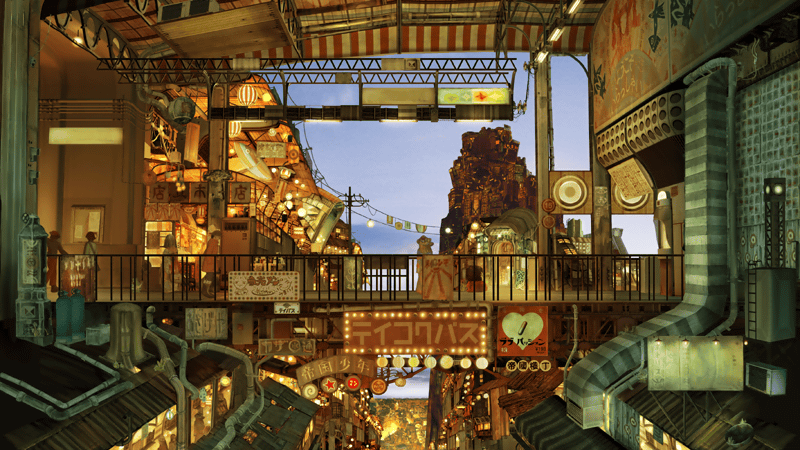
Teikoku shônen - art nouveau punk?

I read a comment about Teikoku Shônen (aka Imperial Boy) some time ago: ”I simply love.. So much so, that it breaks my heart a bit to know that I'll never live in such beautiful places.”

Here's a sample of his work (for more, see his web-page)


There's an excellent blog entry about him here: Hunting the Elusive. Below I'm going to quote a few passages from it, while adding my own commentaries. Since I'd like this entry to be something in the way of an inventory of themes that I find in these works, I will treat them under a number of headings: postmodernity and colonialism, nature and history, ecology and junk, and childhood and loss.


Postmodernity and colonialism

"What it really is, is a world without the ideas of minimalism or architectural modernism. It is a rejection of the simple for the complex, the space for the clutter. Roads and buildings are piled one upon the other like space is at a premium." This description is very much to the point. Without stating so explicitly, the statement suggest, I believe, the "postmodern" feel of this world. This in turn might be related to what the author of the blog calls "the unabashedly Japanese feel of his cities". Let me quote again: "This is no steam-punk imagining of European lineage. It is a strictly Japanese or Asian world which manages to look quaint/retro and technologically complex at the same time." Other elements that seem to reflect experiences of Japanese society might include the middle-class feel of these cities and the lack of overt class distinctions. So, is this a variety of techno-orientalism? Maybe, but if that is the case, I think we need to add that techno-orientalism itself is not simply an imaginary construct, but also contains a kernel of truth that is rooted in the way modern Japanese society developed.  

Look for instance at this:


The upper right half of the picture is grey, dominated by a huge-looking concrete bridge across which a tank is being transported. Below it glitters another world of teeming crowds and small-scale commerce. What the picture suggests is a form of colonial economy, in which the modernizing hand of the developmental state is heavily yet insecurely imposed on top of a local, older and more energetical economy. Much like in what economists call Japan's "two-tiered economy", two layers of economic activity seem to co-exist without integration. This colonial economy is also what produced the techno-oriental mix of high-tech and "tradition", which is thus not entirely a fictional construct but reflective of a certain path of state-led modernization.

I use the word "colonial" to describe this economy in order to stress the similarities between Japan and other non-Western countries. The techno-oriental mix of high-tech and premodernity can just as easily be found in Cairo or Abidjan. The gap between intellectuals and the "masses" - a prominent theme in debates in Japan during the early postwar decades and a central concern of intellectuals like Yoshimoto Takaaki - is another manifestation of the same mix. This is a gap we find in many developing countries, in which the efforts of the intelligentsia to connect to the masses are often handicapped both by the latter's indifference and by the allergy of authoritarian governments to a politically active citizenry. Situations that are "colonial" in this wide sense are conductive of a certain kind of postmodern semblance: in countries like this, enlightenment will always seem precarious, almost engulfed by the indifference of things and insignificant in relation to the complex workings of the whole. That Japan is sometimes labelled a postmodern society par excellence is partly explained by this fact. China and other authoritarian late-developers intent on pushing forward with a technological and economical development without popular participation for the masses will probably be great producers of postmodernity.


Nature and history

However, despite the city being the product of a modernization unevenly imposed from above, the city can hardly be said to have an inhuman feel. It can hardly be described as a machine-like and reified "second nature" in which inhabitants are little more than cogwheels. It seems to me that the explanation can be found in the pictures themselves. Looking at them, one has the distinct feeling that state-led modernization is no longer really relevant to the way citizens lead their lives. Although immense energies must once have been poured into erecting the towers, the bridges, highways and buildings, one feels as if all this was a thing of the past, as if all these immense structures had been there since very ancient times - perhaps like rocks, mountains or other geological formations - and that no really disruptive changes could really happen anymore. The changes that do happen - the proliferation of human habitat, small shops and passageways along the contours of these structures - are of another and smaller order, piecemal and improvised, similar to the growth of vegetation on top of slopes, rocks or fallen gigantic trees. This clutter and proliferation, one feels, cannot possibly have been planned or imposed from above.


Part of the nature-likeness of these cities is the sheer abundance of real organic nature in them: vegetation, water, clean air. "His cities are so bright and clean, they're almost an imagining of what technologically-advanced cities would be like without pollution... Wood, plants, trees and greenery are present throughout the cities, and he also has an obsession with waterways replacing roads as conduits".


Why doesn't this nature feel inhuman or oppressive? That's a great riddle (one which I once tried to solve in a book that discussed the "naturalized modernity" in the fiction of Murakami Haruki and other writers and how this modernity differed from the shocking and reified "second nature" of Lukács). Perhaps the best answer is simply to remind oneself that the agents of this nature-like proliferation are human beings - people who, regardless of governments or big organizations - try to arrange a habitable everyday life for themselves by building this or that or putting things here or there according to their needs and tastes, without any thought of the whole.

Let us recall that "history" - the concept usually counterposed to "nature" - is best described as an environment which allows itself to be changed and reshaped by the efforts of people and where one can also see the traces of or imagine the processes of change that has led to the present state. Defined in this way, we may, perhaps to our surprise, discover that things in nature often inspire feelings of history. Plants decay and wither. Forests don't stand still. Today we see moss growing where yesterday there was none. Everything seems pregnant with change which is easily imaginable. These cities are the same. They are nature in which humanity is part, not a nature opposed to humanity. Conversely, the humanity inhabiting it is one which no longer defines itself in opposition to nature. 

As mentioned, the experience of this nature is probably at least partly rooted in real experiences of Japanese modernization. What the pictures confront us with is therefore not solely a fantasy, but also the memory of our own real experiences. If we therefore ask, for instance, whether these pictures are not ideological in a bad sense - i.e. whether they attempt an impossible reconciliation between social forces that are in reality irreconcilable - we should also ask the same question of our own experiences. To the extent that we indulge in, and tolerate, the nature-like semblance of certain cities, aren't we also condoning a certain elision, a certain ideological foreclosure?


Ecology and junk

A word about junk here. I have already mentioned that "class" and segregation seems to have left no traces on the way these cities are organized (this is another difference compared to much cyberpunk fiction). How about waste then? Where would cities like this, if they existed, dispose of their waste? One of Teikoku Shônen's most impressive works depicts an undergrown arcade, according to the caption constructed out of waste materials and junk:


Above I quoted the perceptive statement that these cities seemed surprisingly ecological and lacking pollution. At the same time, I have argued that humanity itself "grows" on these cities in an unplanned way. Am I perhaps too bold if I interpret this to mean that here, where no junk is visible, all is junk? The city itself is made out of junk. Just as nature is no longer excluded, junk too is redeemed and for that very reason no longer appears as junk. If Hell is where all junk ends up, is Hell not exactly for that reason precisely so open, generous and free from exclusion as Heaven really ought to be? Is a junkheap an image of Heaven or Hell?


Childhood and loss

I would say: his pictures are attempts to resurrect the memory of how we once experienced things when we were children or adolescents - when everything looked big, exciting and full of wonder. Isn't this why everything in these cities seems so overdimensioned, so unfathomably complex and convoluted, so endlessly big? Looking at a world like this, who cannot help feeling that everything is beginning anew and that there is so much left to explore?

These pictures, then, not so much dream images of the future as nostalgic, loving flowerings of imagination around things that are disappearing. By watching them, we prepare ourselves mentally for the loss, reassuring ourselves that the best in what we are losing is preserved in them. This is not necessarily good, but the extent to which his images succeed in making us feel this way testifies to their power.

I asked above if these images weren't ideological. That was no more meaningful than to ask whether dreams are ideological. Very few people mistake dreams for reality. What is at stake is rather the desire expressed in the dream.


Saturday, 11 December 2010

Murakami Haruki, reality, trauma

A just read Murakami Haruki's essay in the New York Times, "Reality A and Reality B".

Note first the inversion: something has happened which has made the real world change places with the unreal. The unreal, contrafactual world of what never happened has become more real to us than the real world we’re inhabiting.

The analogy seems to be that of traumatization. In a traumatized state, the ego is trapped in the past, which is more real than the present, which has turned into a meaningless and indifferent chaos. The structure of the inversion is the same.

Note Murakami's huge ambitions, which almost seem to border on hubris or at least on the heroic. Words must be coined, he asserts, that help connect past and future. The task he sets himself as a teller of stories is, in other words, the healing of the world – its recovery. The teller of stories takes on the role of a healing angel or boddhisattva surveying the disaster.

Many have written a lot about the shift from detachment to commitment in Murakami’s writings in the 90s. In the 80’s, he could still write – as he does in his masterpiece Hardboiled Wonderland and the End of the World – how life is like a beach where junk is washed ashore by the waves and then washed back into the sea.
When I look back over my life so far, I see all that junk on the beach. It’s how my life has always been. Gathering up the junk, sorting through it, and then casting it off somewhere else. All for no purpose, leaving it to wash away again.[…] This is all my life. I merely go from one beach to another. Sure I remember the things that happen in between, but that’s all. I never tie them together.
Here too an inversion has occurred. And it occurs on many planes. Compared to the earlier text, detachment has turned partially into commitment, acceptance of discontinuity into a stoic groping for words that tie together, and self-chosen isolation has turned into the shouldering of what almost appears as a communal task. But underlying it all is a continuity – a chilly sadness at what one of his contemporary soul mates, Thomas Pynchon, called ”the spilled, the broken world”.

I won’t venture further here into the many questions that open up here. Let me just say that I think there is much that speaks for a view of the world as traumatized, just as Murakami suggests. I once wrote that being an angel was revolutionary. That may sound silly. But in a traumatized world, it’s true.